The Complete Guide to Tractor Lighting: Work, Cab, Beacon & Tail Lights Explained
In this guide
- Why Tractor Lighting Matters
- Understanding Light Output and Angles
- The Main Types of Tractor Lights
- Lighting Layout Examples for Different Farm Work
- Choosing the Right Lighting Setup
- Common Tractor Lighting Mistakes
- Troubleshooting Lighting Issues
- LED vs Halogen Tractor Lights
- Legal Requirements for Tractor Lighting in Ireland
- Lighting Maintenance Checklist
- Energy Efficiency and Environmental Impact
- Lighting and Farm Safety Culture
- The Future of Tractor Lighting
- Key Takeaways
- Building a Safe, Efficient Lighting Setup
Tractor lighting • Work lights • Cab lights • Beacons • Tail lights • Irish rules
The Complete Guide to Tractor Lighting: Work, Cab, Beacon & Tail Lights Explained
Lighting is one of the most important yet often underestimated aspects of modern farming.
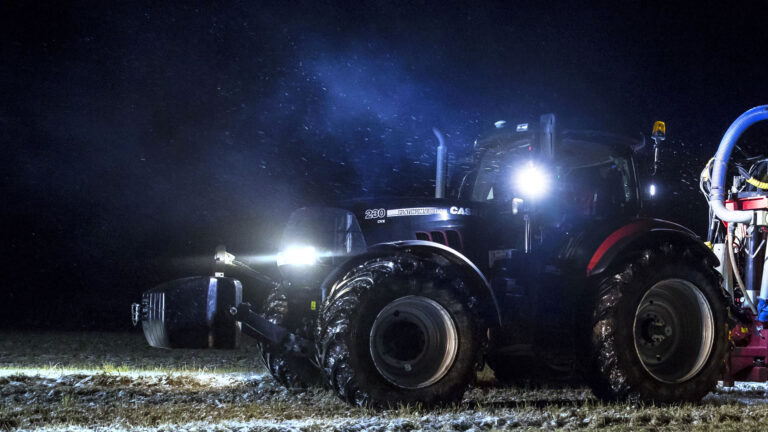
Finishing silage late into the night, feeding livestock before dawn, or travelling between fields on unlit county roads, your tractor lighting setup plays a major role in how safely and efficiently you can work.
This guide explains everything you need to know about tractor lighting, from work and cab lights to beacons and tail lights, covering how they function, how to install and maintain them, and what to look out for when upgrading to modern LED systems.
Why Tractor Lighting Matters
Every farmer has experienced those long nights where work continues well after sunset.
In those moments, lighting becomes more than a convenience. It becomes a safety tool.
The right setup lets you clearly see your working area, spot obstacles, and handle equipment with confidence.
Without proper lighting, simple tasks like reversing a trailer, loading bales, or checking a hitch can turn into safety hazards.
In Ireland, tractors are often driven on roads between fields and outfarms or to transport goods.
Poor visibility can be a real danger, especially on narrow local roads or in foggy conditions.
A visible, compliant lighting setup makes your tractor easier for other road users to see, helping to prevent collisions.
Dawn and dusk, when light is poor, are particularly risky times for farm vehicles on the road.
Lighting is also about performance.
Being able to see clearly allows you to maintain straight lines while ploughing, ensure accurate drilling, and reduce eye strain.
A well-illuminated working area can improve productivity and reduce fatigue during long hours in the cab.
Understanding Light Output and Angles
The quality of your lighting depends on several technical factors.
The first is brightness, measured in lumens.
Standard halogen bulbs produce around 1,000 lumens, while modern LED units can produce over 5,000.
However, more lumens do not always mean better lighting. What really matters is how that light is distributed.
The beam angle determines light coverage.
Narrow beams, around 30 degrees, concentrate light into a small area and are ideal for long-distance field work such as drilling.
Wider beams, 60 to 90 degrees, spread the light across a broader area, perfect for loading or harvesting.
Most farmers achieve the best results with a combination of both flood and spot lights.
Colour temperature also plays a role.
LEDs producing light between 5,000K and 6,000K create a bright, daylight-like effect that improves visibility and reduces eye strain.
It is worth testing different setups to find what works best for your environment.
The Main Types of Tractor Lights
A tractor’s lighting system combines several types of lights, each serving a different purpose.
Together, they ensure you can see your work clearly and stay visible to others, whether in the field or on the road.
Work Lights: Field and Yard Visibility
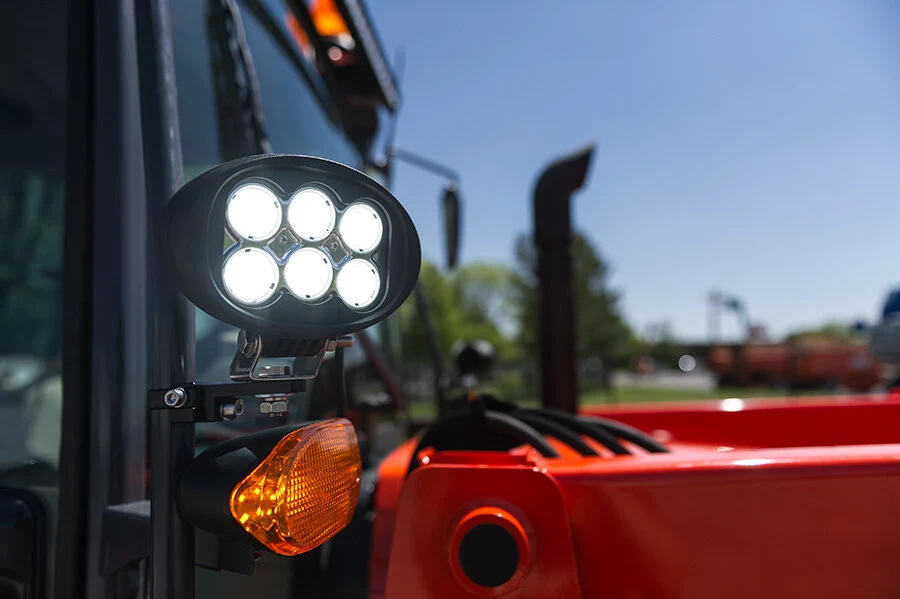
Work lights provide the illumination needed for night operations in the field or yard.
They are typically mounted on the cab roof, mudguards, or implement frames.
LED work lights have become the preferred option because they offer strong brightness with low power consumption and resist vibration better than halogen bulbs.
Correct positioning matters.
Front-mounted lights should be above the bonnet to avoid shadows, while rear lights should illuminate implements without dazzling the operator or reflecting off mirrors.
Many operators also add side-facing lights to cover blind spots.
A balanced layout ensures consistent coverage across the whole working area.
Headlights and Tail Lights: Road and Field Use
Headlights and tail lights are the main components that make your tractor road legal.
Headlights help you see where you are going, while tail lights, brake lights, and indicators make you visible to others.
In Ireland, tractors must have side lamps, headlamps, rear lamps, stop lamps, direction indicators, a flashing amber beacon and number plate lighting, with an exemption for older tractors (pre-1980, or 30+ years old according to current RSA guidance) used only in daylight.
Since 1 January 2016 this full system must be in place and working whenever the tractor is on a public road, not just during lighting-up hours.
LED headlights have become standard because they produce a cleaner, whiter light and use less power.
Tail lights and reflectors should always be checked for mud and damage to ensure maximum visibility.
For wide equipment or trailers, extension lights or magnetic units are a practical solution.
Cab Lights: Operator Comfort and Control
Cab lighting may not affect how you see outside, but it has a big impact on comfort.
A bright, evenly lit cab helps operators monitor controls, screens, and gauges during long shifts.
It also reduces strain when switching between bright and dark environments.
Many modern tractors include red or dimmable lights to preserve night vision.
If your tractor has older interior bulbs, upgrading to LED strips or panel lights is an easy way to improve visibility while using less energy.
Beacons and Warning Lights: Farm Safety Essentials
Amber beacons are one of the most important safety tools on a tractor.
They warn others of a slow-moving vehicle. In Ireland, every agricultural tractor and self-propelled agricultural machine must be fitted with a flashing amber beacon, and it must be switched on whenever the vehicle is on a public road, on any type of road and at any time of day. Only vintage tractors used solely for rallies or display are exempt.
LED beacons are more reliable than traditional rotating types, as they contain no moving parts and use less power.
To be effective, beacons should be mounted on the roof where possible, on the centre line of the tractor, and kept clean.
A dirty or cracked lens can drastically reduce visibility.
Implement and Auxiliary Lights: Extended Use Cases
Agricultural trailers need their own side lamps, rear lamps, stop lamps, indicators and number plate lighting for road use, and towed equipment such as balers or sprayers needs a lighting board if it hides the tractor’s own lamps.
These include brake lights, indicators, and reflectors connected to the tractor via a secure plug.
Poor wiring or worn connectors are common causes of lighting failure, so regular inspection is essential.
Portable magnetic lights are also useful for temporary setups.
Lighting Layout Examples for Different Farm Work
Different types of work benefit from different lighting arrangements.
For general fieldwork, four lights at the front and two at the rear often provide ideal coverage.
Front lights can be angled outward slightly to minimise glare from the bonnet, while rear lights should focus on implements and the area immediately behind the tractor.
For livestock yards or close-quarter work, side-mounted flood lights provide excellent visibility when manoeuvring near animals or walls.
In transport situations, keep lights aimed low and forward to avoid dazzling oncoming drivers.
Loading operations benefit from a single bright light positioned above the loader boom or bucket.
Choosing the Right Lighting Setup
Choosing the right lighting depends on the type of work you do and the environment.
If most of your work is field-based, wide flood lights will help illuminate large areas.
For road travel, properly aligned headlights matter most. RSA guidance says work or ploughing lamps must be switched off before using the public road.
It’s also wise to check voltage compatibility and use relays for protection.
If you’re upgrading an older tractor, many LED work lights are available that fit existing mounts without altering factory wiring. For road headlamps, fit a complete approved LED headlamp unit rather than an LED bulb in a halogen housing, which is not road legal.
These retrofit solutions are a cost-effective way to improve brightness without affecting originality.
When installing new lights, use waterproof connectors and secure all cables away from moving parts.
Common Tractor Lighting Mistakes
Lighting issues are often caused by poor installation or incorrect wiring.
Overloading a single circuit can cause overheating or fuses to blow.
Splitting circuits and using relays prevents this.
Poor grounding is another common cause of flickering lights, so always make sure connections are clean and tight.
Incorrect beam angles also cause problems.
Lights aimed too high can blind others or reflect off the bonnet, while lights pointed too low limit visibility.
Testing at night before final tightening helps you achieve the best alignment.
Troubleshooting Lighting Issues
When lights start to flicker or fail, there are a few simple checks you can make before calling for help.
Start with the fuse box and replace any blown fuses.
Then inspect wiring for frayed insulation, corrosion, or water ingress.
Loose or corroded earth points are the most common causes of failure.
Moisture trapped in the light housing can also cause short circuits.
Replacing damaged seals and applying dielectric grease to connectors helps prevent problems.
Always check that new lights do not exceed your alternator’s power rating.
LED vs Halogen Tractor Lights
LED lights are brighter, cooler, and last much longer than halogen alternatives.
They can withstand vibration and dust better and draw less power.
Although halogen bulbs are cheaper to replace, the lifespan and efficiency of LEDs make them more cost-effective over time.
Legal Requirements for Tractor Lighting in Ireland
Tractors used on public roads must meet the Road Traffic (Lighting of Vehicles) Regulations 1963, as amended. The main agricultural changes came in with S.I. No. 249 of 2014, in force from 1 January 2016.
This means having side lamps, headlamps, rear lamps, stop lamps, direction indicators, a flashing amber beacon and number plate lighting, all in place at all times on a public road, not just during lighting-up hours (half an hour after sunset to half an hour before sunrise). The beacon must be switched on whenever the tractor is on a public road.
Agricultural trailers need side lamps, rear lamps, stop lamps, indicators and number plate lighting, and a side marker lamp is needed when the tractor and trailer combination is over 10 metres long. Using a vehicle not equipped with the prescribed lamps carries a €60 fixed charge. The RSA guidance on agricultural vehicle lighting has the full detail.
Before setting off, always do a quick walkaround check to confirm all lights are working correctly.
Lighting Maintenance Checklist
Regular maintenance ensures your lighting system remains safe and reliable.
Use this checklist to stay ahead:
Weekly: Clean lenses, remove mud, and check all lights for correct operation.
• Monthly: Inspect wiring, replace cracked lenses, and tighten mounts.
• Seasonally: Before harvest or winter, inspect all connectors, apply grease, and confirm brightness levels.
• Off-season: If your tractor is stored, disconnect the battery and cover lenses to protect them from UV and frost damage.
Energy Efficiency and Environmental Impact
Modern LED lighting reduces environmental impact by using far less energy than halogen systems.
LEDs draw minimal current, which eases the load on the alternator and reduces fuel consumption.
Their longer lifespan means fewer replacements and less waste.
For farms looking to improve efficiency, switching to LEDs is a simple yet impactful change.
Are LED tractor lights better for the environment
Lighting and Farm Safety Culture
Good lighting is not just about meeting regulations; it’s a reflection of a farm’s safety culture.
Regularly checking and maintaining lights encourages safe habits and creates a working environment where visibility and awareness are priorities.
Simple steps, such as cleaning lenses before night shifts or replacing worn connectors early, can prevent accidents and reduce downtime.
Training staff to recognise the signs of lighting faults is equally important.
Encourage operators to report dimming or flickering immediately.
Building a proactive attitude towards lighting maintenance promotes responsibility and helps make the entire workplace safer.
The Future of Tractor Lighting
Lighting is evolving rapidly alongside precision farming technology.
Adaptive LED systems, already common on cars, adjust brightness and beam angle automatically based on speed and steering angle, and similar ideas are starting to reach agricultural machinery.
Future designs are expected to integrate with GPS, allowing lighting to focus only on the working area while minimising glare.
Developments in materials and energy storage could also lead to solar-assisted systems and self-monitoring lights that alert the operator when maintenance is needed.
These innovations will not only save time but also contribute to lower emissions and smarter energy use.
Key Takeaways
Use a mix of spot and flood lights for balanced coverage.
• Keep lenses clean and check for alignment regularly.
• Upgrade to LED for long-term savings and reduced maintenance.
• Always stay compliant with Irish lighting regulations, including the beacon on at all times on the road.
• Treat lighting as part of your farm’s safety culture.
Building a Safe, Efficient Lighting Setup
Lighting is more than an accessory, it’s an essential part of working safely and effectively.
By understanding the different light types, positioning them correctly, and maintaining them regularly, you can make your tractor safer, more productive, and more energy efficient.
A well-designed lighting setup gives you confidence to keep working long after the sun goes down, while staying compliant and reducing your environmental footprint.