What are Tractor Beacons and Why They Are Legally Required on Irish Roads
In this guide
- Key takeaways
- Shop amber tractor beacons
- When tractor beacons are legally required in Ireland
- Speed, width, and visibility: the quick triage
- Where tractor beacons should be mounted for maximum visibility
- How tractor beacon technology has evolved
- When to use tractor beacons on Irish roads
- Why tractor beacons prevent accidents
- Common mistakes farmers make when using tractor beacons
- How to choose the right tractor beacon
- Best practices for tractor beacon maintenance
- Why every modern farm should take beacons seriously
- Tractor beacon FAQ for Irish road use
- Next steps: make your tractor visible on Irish roads
Key takeaways
- Amber beacons warn other road users that a tractor is slow, wide, or working near traffic.
- In Ireland every tractor and self-propelled farm machine must have an amber beacon switched on whenever it is on a public road.
- Mount the beacon on the roof on the centre line where possible, at least 1.27 m high, with clear 360° visibility.
- LED beacons typically deliver stronger brightness, better vibration resistance, and longer lifespan than halogen.
- Most failures come from low mounting, dirty or faded lenses, and moisture or corrosion in wiring.
- Buy based on voltage, IP rating, mount type, and true 360° light coverage.
Tractor beacons are one of the most important safety features on agricultural vehicles. A tractor beacon signals a slow-moving vehicle, alerts other road users in poor visibility, and supports safer farm operations. In simple terms, a tractor beacon communicates risk, protects operators, and prevents accidents. This article explains how tractor beacons work, what Irish law requires, and how to use them correctly in real farm settings.
Tractor lighting is easy to overlook during busy seasons, yet it plays a critical role in field safety and road visibility. A tractor that displays a bright amber beacon stands out clearly on a dark lane, while a tractor without one can disappear into shadows or mist. The relationship between tractor, environment, and lighting is one that directly influences safety outcomes. Understanding beacons helps every farmer make better choices for road travel, towing, and farmyard manoeuvring.
- What Irish law requires for tractor beacons
- Where to mount it for 360° visibility
- What to check before you buy
Shop amber tractor beacons
Pick LED, 12V or 24V, and the right mount for your cab. Then add a spare lens and a proper switch so it stays road ready.
- 12V or 24V match
- IP rating for water and dust
- Mount type for your use
- True 360° visibility
Popular choices
- LED bolt-on beacon for daily road travel
- Magnetic beacon for occasional field-to-yard runs
- Flexible stem mount for rough ground vibration
Note: Choose based on use case, not just brightness claims.
When tractor beacons are legally required in Ireland
Use this section to understand the Irish rule and the risks it is there to manage.
Why the law requires a beacon
- ⚠️ Speed risk. Slow-moving tractors need earlier recognition.
- ↔️ Width risk. Wide implements take longer to judge and pass.
- 🌫️ Visibility risk. Mist, rain, dusk, and dawn reduce contrast.
- 🛣️ Roadside work. Verge and hedge work needs a clear warning signal.
The Irish rule is simple: beacon fitted and switched on whenever the tractor is on a public road.
The only exception is vintage tractors used solely for rallies or display.
Speed trigger
A slow vehicle increases closing speed for cars behind.
Width trigger
Wide kit needs earlier warning and clearer judgement.
Visibility trigger
Low contrast makes tractors blend into lanes and villages.
Need a beacon that fits
Match voltage, IP rating, mount type, and 360° coverage.
Full explanation
In Ireland, tractor beacons are a legal requirement on every journey. Since 1 January 2016, under the Road Traffic (Lighting of Vehicles) (Amendment) Regulations 2014 (S.I. No. 249 of 2014), every agricultural tractor and self-propelled agricultural machine must be fitted with a flashing amber beacon, and it must be switched on whenever the vehicle is in use on a public road. The rule applies regardless of the tractor’s speed, width or the type of road, and it was kept when the beacon rules were replaced by S.I. No. 639 of 2020. The only exception is vintage tractors used solely for vintage rallies or display. This is very different from the UK, where a beacon is only compulsory for slow vehicles on fast dual carriageways, so ignore UK advice that says beacons are optional on country roads.
The 2020 rules also set how the beacon is fitted. Where possible it goes on the roof, on the tractor’s centre line, with no part of the lit surface less than 1.27 m from the ground. The light-emitting area must fit within a 230 mm square, and amber lamps are limited to 36 watts. Self-propelled machinery over 3.5 m wide also needs an escort vehicle, flashing amber beacons and a “CAUTION, WIDE LOAD FOLLOWING” sign.
Width and visibility still matter for how well the beacon does its job. When a tractor carries a baler, mower, sprayer, or trailer wider than 2.55 metres, the vehicle becomes harder to judge, and an extra beacon on the implement or trailer may be needed so the light can be seen from behind. Fog, heavy rain, twilight, and dawn all reduce contrast and depth perception. A tractor that displays a bright, clean, well-mounted beacon produces a clear signal, and that signal helps other drivers adjust their speed in time.
Speed, width, and visibility: the quick triage
Use this to decide fast why the beacon matters in your exact situation.
Speed trigger
A slow-moving tractor increases closing speed for traffic behind.
- Drivers misjudge tractor speed at distance.
- Late braking causes tailgates and unsafe overtakes.
- An amber beacon signals slowness earlier than headlights.
Width trigger
Wide kit is harder to judge and needs earlier warning time.
- Implements change the silhouette and passing gap.
- Oncoming drivers need time to slow and position.
- A beacon improves early recognition of a wide load.
Visibility trigger
Low contrast reduces distance judgement and reaction time.
- Mist and rain flatten depth and distance cues.
- Dusk and dawn make tractors blend into lanes.
- An amber beacon creates a separate hazard signal.
In Ireland the beacon is on for every road journey, whatever the triggers.
If two or more triggers are present, prioritise high mounting, a clean lens and a second beacon if the load hides the first.
Where tractor beacons should be mounted for maximum visibility
Use this to choose a position that meets the Irish rules and stays visible from every angle.
Quick placement checklist
- On the cab roof, on the centre line where possible, at least 1.27 m high.
- No blockage from loader arms, frames, tanks, or trailers.
- Rigid base to reduce vibration and pattern distortion.
- Cable routing protected from pinch points and water.
- Clean lens and correct amber colour when lit.
Do this
- Mount above cab line for clear sight lines.
- Use a stable plate or bracket with firm fixings.
- Use twin beacons if you need symmetry and coverage.
- Add an implement beacon if the load hides the tractor beacon.
Avoid this
- Low mounts behind loader arms and cab frames.
- Loose mounts that shake and blur the pattern.
- Mounting where mud and spray coat the lens fast.
- Cable runs that rub, pinch, or sit in water.
A beacon that is technically bright but blocked still fails in practice.
Visibility from the rear is as important as the front.
Full explanation
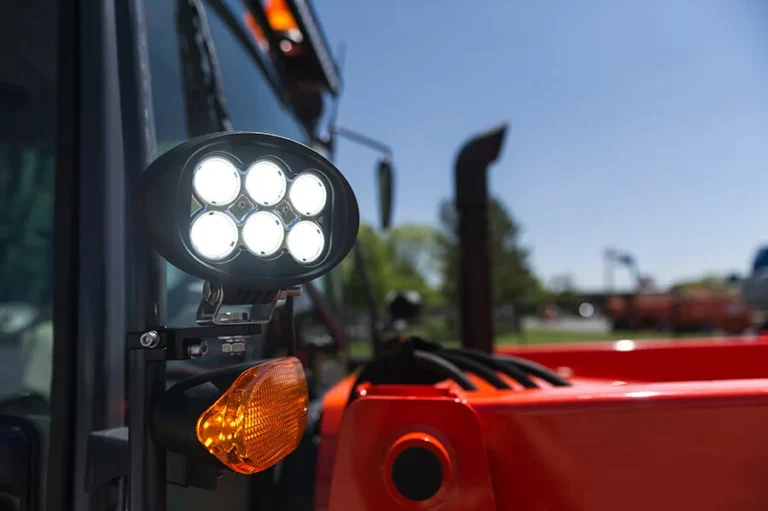
The ideal beacon location is the tractor roof, on the centre line where possible, which is also what the Irish regulations ask for. No part of the lit surface may be less than 1.27 m from the ground, and the light-emitting area must fit within a 230 mm square. A high position increases the viewing angle and allows the light to be seen from all directions. A beacon that sits too low can be blocked by a loader, cab frame, trailer, or sprayer tank. A beacon that sits high avoids obstruction and keeps visibility consistent.
A beacon should sit on a rigid mounting plate. A rigid base reduces vibration and helps the beacon maintain a steady flash pattern. When the beacon shakes excessively, the light pattern becomes harder to recognise. A stable beacon creates a predictable warning signal, and a predictable warning signal improves reaction time for other drivers.
A tractor fitted with a roll bar may use a mounting bracket that sits above the bar. Where a single centre-mounted beacon is not practical, a tractor fitted with twin beacons may place one on each side of the cab. Twin beacons create symmetry, and symmetry improves recognition from both directions. A tractor that tows large or high implements may use an additional beacon on the implement frame. This creates a stronger silhouette and makes the load easier to judge from distance.
How tractor beacon technology has evolved
Use this to choose between halogen rotating and modern LED electronic beacons.
Halogen rotating
- Warmer, dimmer output than modern LED.
- Bulb and mechanical parts need maintenance.
- More prone to failure in wet and dusty conditions.
- Higher power draw for less light output.
LED electronic
- Brighter amber output and clearer optics.
- Better vibration resistance and sealing.
- Longer lifespan with lower current draw.
- Supports multiple flash patterns and simulated rotation.
Flash patterns and what they communicate
- Slow flash. Communicates caution for steady slow movement.
- Fast flash. Communicates increased hazard and higher attention.
- Quad flash. Communicates high notice in poor visibility and complex traffic.
- Simulated rotation. Communicates broad motion and strong presence.
Ready to upgrade
Pick LED, match voltage, then choose a mount that stays stable.
Full explanation
Beacon technology has changed dramatically in the last decade. Older beacons used halogen bulbs and mechanical rotating mirrors. Modern beacons use solid state LED modules that flash electronically. The relationship between technology and safety is simple. LED beacons create brighter light, draw less power, and last far longer.
A halogen beacon needs regular maintenance. A halogen beacon often fails in wet or dusty environments. An LED beacon handles moisture, vibration, and continuous use with ease. The shift from halogen to LED created a major improvement in safety outcomes because LED modules maintain brightness over years of use. Irish rules limit amber beacons to 36 watts, so check the rating before fitting an older halogen unit.
LED beacons also support multiple flash patterns. A tractor operator can choose slow flash, fast flash, quad flash, or simulated rotation. Each pattern supports a different scenario. A slow flash communicates caution. A fast flash communicates increased hazard. A simulated rotation communicates broad motion. The tractor, environment, and pattern create a visual language that improves understanding.
When to use tractor beacons on Irish roads
Use this as a pre-road checklist before you leave the yard.
Beacon on for every road journey, and take extra care when
- ⏱️ Pulling out of the yard or field gate onto any public road.
- ↔️ When towing or carrying a load wider than 2.55 metres.
- 🌾 When entering or leaving fields along narrow lanes.
- 🌫️ When visibility is poor due to weather.
- 🌅 When travelling during twilight, dawn, or full darkness.
- 🧰 When moving implements that overhang or obscure rear visibility.
- 🛣️ When working on verges, hedges, or roadside tasks.
A beacon reduces surprise, reduces misjudgement, and reduces collisions.
Before you pull out
- Clean the lens so the amber stays clear.
- Check the flash pattern looks steady.
- Check the mount does not wobble.
- Confirm rear visibility is not blocked by the implement.
Need a reliable beacon
Choose LED, match voltage, and pick an IP rated unit for farm conditions.
Common slip ups
- Beacon blocked by loader arms or tanks.
- Lens covered in dust or spray.
- Beacon left off for a short road run.
- Import unit with chaotic flash rate.
Full explanation
By law in Ireland, the beacon must be switched on whenever a tractor or self-propelled agricultural machine is on a public road, on every type of road and at every speed. The conditions below are the times when the beacon matters most, and when it is worth checking it is clean, visible from behind and not hidden by the load:
- • When pulling out of the yard or field gate onto any public road.
- • When towing or carrying a load wider than 2.55 metres.
- • When entering or leaving fields along narrow lanes.
- • When visibility is poor due to weather.
- • When travelling during twilight, dawn, or full darkness.
- • When moving implements that overhang or obscure rear visibility.
- • When working on verges, hedges, or roadside tasks.
The relationship between beacon, speed, and visibility is a protective one. A beacon reduces surprise, reduces misjudgement, and reduces collisions.
Why tractor beacons prevent accidents
Use this to explain the human factors behind collisions and near misses.
Drivers misjudge speed and distance
- 🧠 Headlights alone can look like a normal vehicle at distance.
- ⛔ Late recognition leads to sharp braking and tailgating.
- ↗️ Unplanned overtakes happen on bends and narrow lanes.
- 🚜 Wide implements make judgement harder without an early warning cue.
Amber flashing is a hazard cue most drivers recognise fast.
Earlier recognition increases reaction time and reduces impact risk.
What the beacon changes
- 1 Beacon seen earlier.
- 2 Driver slows earlier.
- 3 Overtake decisions become planned, not reactive.
- 4 Collision probability drops.
Scenario
A tractor at dawn without a beacon can blend into dim light.
A bright amber beacon stands out and alerts drivers, cyclists, and pedestrians.
Improve your signal
Choose LED and mount it high so it stays visible from the rear.
Full explanation
Many farm-related road accidents happen because other drivers misjudge speed or distance. A tractor without a beacon often looks like a normal car light pattern from a distance. A driver behind may assume the vehicle is travelling faster than it is. Misjudgement leads to sharp braking, swerving, or unsafe overtaking.
A tractor beacon prevents these issues because it communicates slowness immediately. The human brain recognises amber flashing lights as a hazard cue. The relationship between beacon signal and driver behaviour is predictable. When a driver sees a beacon, the driver slows down earlier. When reaction time increases, accident probability decreases.
A tractor that travels through a village at dawn without a beacon may blend into dim light. A tractor that displays a beacon stands out clearly. The beacon alerts pedestrians, cyclists, and car drivers who rely on contrast to judge movement.
Common mistakes farmers make when using tractor beacons
Use this section as a fast fault check when a beacon exists but does not help.
⬇️
Beacon is mounted too low
A low beacon sits behind cab frames, loader arms, or trailers. A blocked beacon reduces visibility and creates inconsistent signalling. A high mounting solves this problem.
🧼
Beacon lens is dirty or faded
A dirty lens reduces brightness. A faded lens changes colour from amber to pale yellow. A lens that loses colour no longer shows the amber the regulations require. Regular cleaning keeps the beacon effective.
⏱️
Beacon is switched off on the road
Irish law requires the beacon on whenever the tractor is on a public road. A beacon left off for a short run between fields still breaks the rule. Work and ploughing lamps, on the other hand, must be off on the road. Make switching the beacon on part of leaving the yard. A consistent signal creates trust.
⚡
Beacon flash rate is incorrect
Some imported beacons flash at very high speeds or irregular intervals. A steady, moderate flash rate is easier to read, and ECE R65-approved beacons are tested for flash behaviour. A pattern that is too fast looks chaotic, and chaos reduces comprehension.
- Move the beacon higher and check rear visibility.
- Clean the lens and replace it if the amber looks pale.
- Switch the beacon on every time you enter a public road.
- Replace any unit with an erratic flash pattern.
Full explanation
Even experienced operators can make beacon mistakes that reduce safety. Here are the most frequent issues:
Beacon is mounted too low: A low beacon sits behind cab frames, loader arms, or trailers.
A blocked beacon reduces visibility and creates inconsistent signalling.
A high mounting solves this problem.
Beacon lens is dirty or faded: A dirty lens reduces brightness.
A faded lens changes colour from amber to pale yellow.
A lens that loses colour no longer shows the amber the regulations require.
Regular cleaning keeps the beacon effective.
Beacon is switched off on the road: Irish law requires the beacon on whenever the tractor is on a public road.
A beacon left off for a short run between fields still breaks the rule.
Work and ploughing lamps, on the other hand, must be off on the road.
Make switching the beacon on part of leaving the yard.
A consistent signal creates trust.
Beacon flash rate is incorrect: Some imported beacons flash at very high speeds or irregular intervals.
A steady, moderate flash rate is easier to read, and ECE R65-approved beacons are tested for flash behaviour.
A pattern that is too fast looks chaotic, and chaos reduces comprehension.
How to choose the right tractor beacon
Use this checklist to pick the right unit first time, then buy with confidence.
Buying checklist
Check these before you buy
- 💡 Light type. LED is brighter, draws less power, and lasts longer.
- 🧲 Mounting style. Magnetic for occasional use, bolt-on for daily use, flexible stem for vibration.
- 💧 IP rating. Aim for IP67 or IP68 for water and dust resistance.
- 🔌 Voltage. Match 12V or 24V to avoid overload or dim output.
- 360° Visibility angle. Choose true 360° coverage with no dead zones.
A high mount and a clean lens often beat chasing the highest lumen claim.
Choose by use case
Daily road travel
Bolt-on LED, rigid mount, IP67+.
Occasional field to yard
Magnetic LED, quick on and off, store dry.
Rough ground vibration
Flexible stem mount, stable wiring, sealed connectors.
Shop beacons
Filter by voltage, mount type, and LED to match your tractor.
Avoid common buying errors
- Buying 12V for a 24V tractor.
- Choosing a unit with rear dead zones.
- Choosing a weak mount for loader work.
- Ignoring IP rating for wet seasons.
Full explanation
Choosing a beacon depends on environment, frequency of use, and mounting type. The following factors matter:
Light type: An LED beacon creates strong light, uses little power, and lasts for years.
A halogen beacon has a lower cost but fails faster.
The relationship between LED brightness and user safety is well established.
Mounting style: A magnetic beacon suits occasional use.
A bolt-on beacon suits daily use.
A flexible stem mount absorbs vibration on rough ground.
When the beacon and the tractor environment align, the system becomes safer.
IP rating: A beacon with an IP67 or IP68 rating resists water and dust.
A high rating protects the internal electronics and prevents early failure.
Voltage: Tractors may use 12V or 24V systems.
A beacon must match the tractor’s voltage to prevent overload or dim output.
Visibility angle: A beacon should provide 360-degree visibility.
Some cheaper beacons create dead zones.
A beacon that uses a wide lens and multi-LED ring produces even coverage.
Best practices for tractor beacon maintenance
Use this as a weekly routine so the beacon stays bright, legal, and reliable.
Quick maintenance checklist
- 🧼 Clean the lens weekly during high-dust seasons.
- 🔧 Tighten the mounting bolts each month.
- 🔌 Check wiring for moisture and corrosion.
- ✅ Test the flash pattern before entering public roads.
- 🪟 Replace cracked lenses immediately.
- 📦 Store magnetic beacons in a dry cab pocket when not in use.
Why this matters
A clean lens and stable mount often increase real visibility more than a new unit.
Simple schedule
- Weekly
Clean lens and check output colour.
- Monthly
Tighten mounts and inspect cable runs.
- Before road
Test flash pattern and rear visibility.
Keep these spares
- Spare lens or lens cover.
- Inline fuse and a spare connector.
- Mounting hardware for your bracket type.
- Cable protection sleeve for rub points.
Replace a tired unit
Pick LED, match voltage, and choose IP67+ for farm conditions.
Full explanation
Maintaining a beacon is simple, yet many farms forget to do it. These steps improve lifespan and reliability:
- • Clean the lens weekly during high-dust seasons.
- • Check the wiring for moisture and corrosion.
- • Test flash pattern before entering public roads.
- • Tighten the mounting bolts each month.
- • Replace cracked lenses immediately.
- • Store magnetic beacons in a dry cab pocket when not in use.
A tractor that carries out regular lighting checks operates more safely. A farm team that treats lighting as part of safety culture creates lower accident risk.
Why every modern farm should take beacons seriously
Use this as the closing section that links safety, compliance, and daily operations.
A beacon is a signal, not a decoration
- 📣 A beacon communicates risk to other road users fast.
- 🛡️ A beacon protects operators by reducing surprise and misjudgement.
- ✅ A beacon is a legal requirement on every Irish tractor on a public road.
- 🚜 Bigger kit and longer hours make early warning more valuable.
High mounting, clean lens, and correct use beat a cheap unit left off.
Why this matters more now
- Larger machinery and wider implements on tighter roads.
- More mixed traffic on rural lanes and village routes.
- More low-light travel in winter work patterns.
- More roadside jobs where drivers do not expect a tractor.
Upgrade your beacon setup
Pick LED, match voltage, then choose a mount that stays stable.
One-line decision rule
If your tractor is on a public road, the beacon is on.
Full explanation
A tractor beacon is more than a legal box to tick, although in Ireland it is that too. It is a communication tool that tells other road users what the tractor is doing. A tractor that displays a strong beacon protects the operator. A tractor that displays no beacon creates doubt and danger. When road accidents involve agricultural vehicles, visibility failures are often a contributing factor. A beacon reduces those failures.
Farmers increasingly operate larger machinery, tow wider implements, and work longer hours. The relationship between tractor size, speed variation, and crowded rural roads makes beacons essential. When a beacon creates early warning, every road user benefits.
Tractor beacon FAQ for Irish road use
Use these quick answers to remove doubt on the law, mounting and buying.
Are tractor beacons legally required on Irish roads?
Yes. Since 1 January 2016 every agricultural tractor and self-propelled agricultural machine must be fitted with a flashing amber beacon, switched on whenever it is used on a public road (S.I. No. 249 of 2014, kept by S.I. No. 639 of 2020). The only exception is vintage tractors used solely for vintage rallies or display.
When must a tractor display an amber beacon on the road?
Every time it is on a public road, on any type of road and at any speed. There is no Irish equivalent of the UK rule that only applies on fast dual carriageways, and tractors that use motorways must have the beacon on there too.
Does width change the beacon rules for tractors and implements?
Not for tractors, because the beacon is required at every width. Self-propelled machinery over 3.5 m wide also needs an escort vehicle, flashing amber beacons and a “CAUTION, WIDE LOAD FOLLOWING” sign. For wide implements over the 2.55 metre standard width, add a beacon on the implement if it hides the tractor beacon from behind.
Where should a tractor beacon be mounted?
Mount the beacon on the cab roof, on the centre line where possible, with no part of the lit surface less than 1.27 m from the ground. Avoid low mounts behind loader arms, tanks, cab frames, and trailers.
LED beacon vs halogen beacon, which is better?
LED beacons give brighter amber output, lower power draw, and longer service life. Halogen rotating beacons need more maintenance and fail more often in wet and dusty conditions.
What voltage beacon do I need, 12V or 24V?
Match the beacon voltage to the tractor electrical system to avoid dim output or damage. Check the tractor battery and alternator system before buying a 12V or 24V beacon.
What IP rating should a tractor beacon have?
Choose a beacon with an IP67 or IP68 rating for water and dust resistance in farm conditions. A higher rating protects electronics and reduces early failure.
Next steps: make your tractor visible on Irish roads
Use these links to go from “understand beacons” to “fit the right setup”.
Amber tractor beacons
Filter by LED, 12V or 24V, mount type, and IP rating.
Tractor lighting checklist before road travel
Headlights, rear lights, indicators, reflectors, and beacon checks in 2 minutes.
Read the checklist
12V vs 24V tractor electrics: how to confirm your system
Avoid the wrong voltage beacon, dim output, and blown fuses.
Read the guide
Beacon mounting: magnetic vs bolt-on vs flexible stem
Choose the mount that stays stable with vibration and loader work.
Read the guide
IP ratings explained for farm lighting
What IP67 and IP68 mean for water, dust, and pressure washing.
Read the guide
- ✅
Shipped from Lincolnshire, with free delivery to Ireland on orders over €150.
- 🧰
Help choosing voltage, mount type, and fitment.
- 📞
Need advice, call +44 1522 440522 or email [email protected].