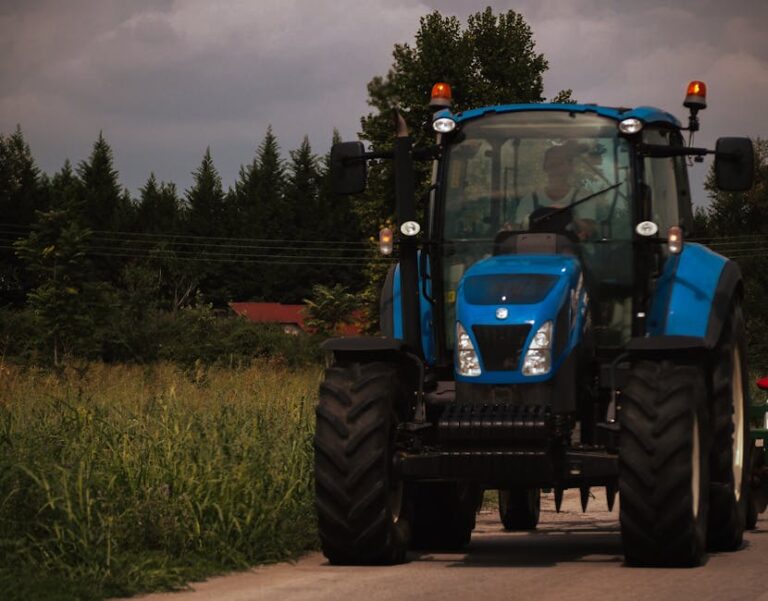
EMC Compliance: Why It Matters for LED Lights on Modern Tractors

In this guide
- What EMC Compliance Means
- Why LED Lights Generate Electromagnetic Noise
- The Regulations: ECE R10, CISPR 25 and EN 55032
- Symptoms of Non-Compliant LED Lights on a Tractor
- How to Identify an EMC-Compliant LED Work Light
- EMC Class A vs Class B and What Each Means
- Cost Difference Between Compliant and Non-Compliant LED Lights
- How to Fix a Noise Problem From an Existing LED Lamp
EMC compliance is the ability of an electrical product to operate without generating electromagnetic noise that disturbs other equipment, and to keep working when other equipment generates noise around it. EMC matters for LED tractor lights because the switching driver inside every LED lamp produces electromagnetic emissions in the radio-frequency band, and a non-compliant LED can interrupt GPS, ISOBUS, ECU, AM radio and 2-way radio on a modern tractor. The minimum EMC standard for road-going LED lights in Europe is ECE R10 (also called UN R10), and many makers also publish CISPR 25 test results. This guide covers what EMC compliance means, why LED lights generate noise, the regulations, the on-tractor symptoms, the markings to look for, the class definitions, the cost gap, and how to fix noise from a lamp already fitted.
What EMC Compliance Means
EMC compliance means a product has been tested and certified to meet defined limits for electromagnetic emissions and immunity. Emissions are the electromagnetic energy a product radiates into its surroundings or feeds back through its power supply. Immunity is the product’s ability to keep working in the presence of electromagnetic energy from outside sources.
Every electrical device with switching electronics generates emissions. The level depends on the design. A well-designed LED driver with proper filtering, shielded cabling and a metal housing emits very little. A cheap LED driver with no filter, plastic housing and poor PCB layout emits enough to be heard as a hum on a nearby AM radio.
Three things EMC compliance proves about an LED work light.
- Conducted emissions back into the supply cable are below the regulatory limit.
- Radiated emissions from the lamp body and cable are below the regulatory limit at every frequency in the test range (usually 150 kHz to 1 GHz).
- The lamp continues to function when exposed to defined external electromagnetic fields.
For modern tractors with GPS auto-steer, RTK correction, ISOBUS implements and CAN-bus engine management, EMC compliance is the difference between a lighting upgrade that improves the working day and a lighting upgrade that makes the tractor unusable. For a deeper look at how this affects precision farming, see Do LED Lights Interfere with GPS and Auto-Steer Systems.
Why LED Lights Generate Electromagnetic Noise
LED lights generate electromagnetic noise because their drivers use high-frequency switching to convert the 12V or 24V supply into the constant current needed by the LED chips. The switching frequency typically sits at 100 kHz to 2 MHz, with harmonic emissions extending up to 1 GHz. Every switching transition radiates a small pulse of electromagnetic energy, and the pulses repeat hundreds of thousands of times per second.
The 4 noise sources inside an LED work light.
- The buck or boost converter switching transistor. Each on-off transition creates a sharp current edge that radiates broadband noise.
- The output ripple on the LED current path. The unfiltered output of a switching converter contains AC ripple on top of the DC current. The ripple radiates from the LED wiring inside the housing.
- The supply cable. The supply cable acts as an antenna for noise on the input side of the driver, both transmitting (radiated emission) and receiving (immunity issue).
- The PCB trace layout. Long traces on the driver PCB act as small antennas. Poor layout amplifies emissions; tight layout suppresses them.
Halogen and xenon lamps do not have this problem in the same way. Halogen is a passive resistive load with no switching, and produces no measurable RF emission. Xenon ballasts switch at high frequency too, but the housing design is usually heavily shielded because xenon has been on cars since the 1990s and the EMC requirements were embedded in the original product design.
LED arrived later and the cheap end of the market often skipped the filtering and shielding. The gap in emissions between a non-compliant LED and a compliant LED of the same brightness can be large across the bands farm vehicles rely on, from AM and FM radio through the VHF and UHF two-way radio bands, and in bad cases up to the GPS L1 band at 1,575 MHz. For more on LED durability and quality, see LED Lifespan: How Long Do LED Work Lights Actually Last.
The Regulations: ECE R10, CISPR 25 and EN 55032
The regulations that govern EMC for vehicle LED lighting fall into 3 categories: vehicle type approval (ECE R10), automotive component testing (CISPR 25), and general electronic product testing (EN 55032 or EN 55015). The applicable standard depends on whether the lamp is fitted to a road-going vehicle, an off-road machine, or a stationary installation.
ECE R10, the road-vehicle EMC regulation. Issued by UNECE and adopted into EU law (so it applies in Ireland) as the EMC requirement for type approval of vehicles and electronic vehicle components. An LED lamp marked with R10 has passed the conducted and radiated emission tests for fitment to a road-going vehicle. The marking appears as the letter E inside a circle, followed by a country number and the approval number. R10 is the standard most farmers should look for on any LED lamp they intend to use on a road-legal tractor.
CISPR 25, the automotive EMC test method. CISPR 25 is the international standard test procedure that defines the emission limits and the test setup used to certify automotive electronic components, including LED lamps. ECE R10 uses test methods based on CISPR 25. Class 5 is the strictest level (lowest permitted emissions), used by manufacturers building components for vehicles with sensitive on-board electronics. Premium makers often state the CISPR 25 class reached in their datasheets.
EN 55032, the general product EMC standard. EN 55032 covers multimedia equipment but is sometimes referenced for LED products that are not intended specifically for vehicle use. An LED with EN 55032 Class B compliance is suitable for residential and light commercial use but does not necessarily meet the harder vehicle requirements of ECE R10.
The marking hierarchy on a quality agricultural LED work lamp.
- CE mark (general European compliance, says the product meets the relevant EU directives).
- ECE R10 marking (specific automotive EMC approval, with E-number visible).
- ECE R65 marking (where the lamp is also a beacon).
- CISPR 25 Class 3, 4 or 5 statement in the technical specification sheet.
The CE mark on its own does not prove EMC suitability for vehicle use. Cheap LED imports often carry only a CE mark with no R10. Always look for the R10 if the lamp will sit on a tractor with GPS or sensitive electronics.
Symptoms of Non-Compliant LED Lights on a Tractor
Non-compliant LED work lights produce 5 distinct symptoms on a modern tractor, all of which appear within seconds of switching the lamp on and disappear within seconds of switching it off. The fault is invisible during the day or with the lights off, which is why the link to the LED lamp is often missed for weeks.
Symptom 1, GPS auto-steer drift or dropout. The tractor wanders off line when the LED work lights are on, or the GPS receiver loses signal entirely. An RTK receiver can lose its fix, dropping from centimetre accuracy to the much coarser accuracy of an uncorrected receiver. The effect is worst at dusk and at night when the lights are most likely to be on at the same time as field work.
Symptom 2, AM and 2-way radio interference. AM radio gains a continuous whine, hiss or buzz when the LED is on. UHF and VHF 2-way radios used by farm staff lose intelligibility, with squelch breaking constantly. CB radio shows the same symptom. FM radio is usually less affected because the FM band sits above most LED noise frequencies.
Symptom 3, ISOBUS implement faults. ISOBUS-controlled implements (sprayer section control, planter row control, baler density control) freeze, throw error codes, or partially fail when the LED is on. The implement still works mechanically but the electronic control logic loses its data feed.
Symptom 4, ECU and dash warning lights. Engine ECU and tractor management ECU may flag warning lights or log fault codes when exposed to high RF noise. The fault clears when the LED is switched off but logs remain in the diagnostic memory.
Symptom 5, slow response on cab control panels. Touchscreen displays and rotary encoder inputs feel laggy or skip inputs. The screens may flicker on the display side. The controller is being disturbed by RF energy entering the data line from the LED supply cable.
The symptom-to-cause link is usually proven with a quick test: switch the suspect LED on and off while watching the GPS, the radio or the ISOBUS screen. If the issue tracks the lamp state, the lamp is the source. If a quick test does not isolate it, switch each LED in the bank individually to find the offender.
How to Identify an EMC-Compliant LED Work Light
Identify an EMC-compliant LED work light by checking the body marking, the manufacturer datasheet and the supplier’s stated approvals. The 5 checks below filter out the worst non-compliant imports without needing access to a test lab.
Check 1, look for the ECE E-mark on the lamp body. The marking is a small circle with the letter E and a country number (e.g. E24 for Ireland, E1 for Germany, E11 for the UK, all valid in Ireland), followed by an approval number that includes 10R for the R10 EMC standard. The marking is moulded into the housing or printed on a metal label.
Check 2, look for CE marking with a stated EMC class. CE alone is not enough. The supplier should state which EMC class the product was tested to (CISPR 25 Class 3, 4 or 5; or EN 55032 Class B). A product that mentions only “CE” with no class is suspect.
Check 3, check the technical datasheet for emission limits. A reputable manufacturer publishes the conducted and radiated emission test results, including the test frequency range and the margin against the limit. A vague claim of “EMC compliant” without test data usually means the product was not tested.
Check 4, check the supplier’s evidence pack. Reputable agricultural lighting distributors hold the technical file and EU declaration of conformity for the products they sell. Ask for the declaration of conformity (DoC) for any LED work light intended for a tractor with GPS. A reputable supplier produces it within minutes.
Check 5, check the price. EMC-compliant agricultural LED work lights cost €40 to €235 each. Sub-€20 LED work lights from generic online sellers almost never have R10 approval. The cost of EMC-compliant design (filtering components, metal housing, proper PCB layout) is €6 to €30 per lamp, which is cut entirely from the budget end of the market.
For the wider buying-tier comparison, see Cheap vs Premium LED Work Lights and What IP Rating Do You Need for Agricultural LED Lights.
EMC Class A vs Class B and What Each Means
EMC class A and class B define how strict the emission limits are, and the class needed depends on the environment the lamp will operate in. Class B is the stricter of the two and is the right choice for any LED work light fitted to a modern tractor.
Class A definition. Industrial and commercial environment, where higher background EMC noise is normal and equipment is expected to tolerate more interference. A class A product has higher permitted emissions than class B and is intended for factories, workshops, and commercial premises with no nearby sensitive electronics.
Class B definition. Residential and light commercial environment, where sensitive electronics (radios, computers, vehicle ECUs, GPS receivers) need protection from interference. A class B product has tighter emission limits than class A.
For agricultural use, class B is the correct standard because:
- The tractor cab contains sensitive precision-agriculture electronics.
- The LED work light operates in close proximity to GPS antennas, ISOBUS controllers and ECU modules.
- Other vehicles, farm buildings and residential dwellings within line of sight may also pick up emissions.
CISPR 25, the vehicle component standard, uses its own 5-class system, and its classes do not map directly onto EN 55032 classes A and B. CISPR 25 Class 5 is the strictest level and is used for vehicle components fitted near antenna positions, GPS receivers and engine ECUs. A premium agricultural LED work lamp aimed at GPS-equipped tractors should state CISPR 25 Class 4 or 5 in the datasheet.
A class A LED work lamp may be cheaper but is not the right product for a modern farm tractor. The same lamp may be fine on an older tractor with no GPS or ISOBUS. The class to look for depends on the vehicle, and the safer default for new vehicle fittings is an R10-approved lamp, with class B as the minimum if only EN 55032 is quoted.
Cost Difference Between Compliant and Non-Compliant LED Lights
The cost difference between an EMC-compliant LED work light and a non-compliant equivalent is €18 to €95 per lamp, depending on output and brand tier. The compliant lamp carries the cost of additional filter components, a shielded housing, R10 testing, and the certification documentation.
Typical 2026 prices in Ireland for a 30W to 48W LED work light.
- No-brand non-compliant LED work lamp from a generic online seller. €7 to €25.
- Mid-tier brand with CE mark and stated R10 (LED Autolamps, Britax, Ring). €35 to €105.
- Premium agricultural brand with R10 and CISPR 25 Class 4 or 5 (Hella, Nordic Lights, Vignal). €105 to €290.
The marginal cost of compliance per lamp is €6 to €30. The remaining gap between budget and premium covers heatsinking, driver quality, optic design, ingress protection and warranty. EMC compliance is one of the lower-cost premium features but one of the highest-value for modern tractor use.
The economics across a full LED upgrade. A 6-lamp compliant LED upgrade costs €235 to €700. A 6-lamp non-compliant LED upgrade costs €42 to €140. The €235 to €560 saving on the non-compliant route can disappear in a single afternoon of GPS dropout that wastes a fertiliser pass or stops field work mid-season. For upgrade costs, see the budget tractor lighting upgrade guide.
How to Fix a Noise Problem From an Existing LED Lamp
A noise problem from an existing LED work light has 4 possible fixes, in order of cost and effort. Try the simplest first before replacing the lamp.
Fix 1, fit ferrite chokes on the supply cable. Snap-on ferrite cores absorb high-frequency emissions on the cable. Fit one ferrite at the lamp end of each affected cable, and one at the supply end if cab clearance allows. Cost €4 to €12 per ferrite. Effectiveness varies: works well on conducted noise, less well on radiated noise from the lamp body itself.
Fix 2, re-route the supply cable away from sensitive electronics. Move the LED supply cable at least 300mm away from the GPS antenna cable, ISOBUS cable and any radio antenna lead. Cross any unavoidable junction at 90 degrees rather than running parallel. This costs nothing in parts and 30 minutes per lamp in time. Often resolves marginal noise issues without any other change.
Fix 3, add a noise filter at the supply cable. A small EMI/RFI filter unit (a few capacitors and inductors in a box) wired in series with the LED supply blocks conducted emissions back into the loom. Cost €12 to €35 per filter. Use a filter rated for the lamp current draw. Works well for the most common conducted-emission failures.
Fix 4, replace the lamp with an R10-approved alternative. The reliable solution for a persistent noise problem is to replace the offending lamp with one that carries proper R10 approval. The original lamp can be re-purposed on an older non-GPS tractor or on a fixed yard floodlight where the noise causes no harm. Cost €47 to €235 per replacement lamp.
A combined approach often works best: ferrite chokes plus cable re-routing on every lamp, with R10 replacement only for the worst offenders identified by individual switch testing. Many farms can resolve GPS and ISOBUS interference for under €60 per affected lamp without replacing the lighting.
For the wider work-light buying lens, see the LED work lights guide, and for the universal LED work lamps range, browse the shop.