Work Light Lumens, Lux and Colour Temperature Explained
In this guide
- The 4 Units on a Work Light Spec Sheet
- Lumens: Total Light Output
- Raw Lumens vs Effective Lumens
- Lux: Light on the Job
- Candela: Beam Intensity and Reach
- Lumens vs Lux: Why the Same Lamp Can Look So Different
- Beam Patterns: Flood, Spot, Combo and Wide Flood
- Colour Temperature in Kelvin
- CRI: How True the Colours Look
- Worked Examples for Tractor Jobs
- How to Read a Work Light Spec Sheet
- Frequently asked questions
Work light lumens measure the total light a lamp puts out, lux measures how much of that light lands on each square metre of the area you are lighting, candela measures how intense the beam is in one direction, and colour temperature in kelvin (K) describes whether the light looks warm yellow or cool blue-white. Most LED work lights run at 5,000K to 6,500K.
The 4 units describe different things and cannot be swapped for each other. A lamp with high lumens can still light your work area badly if the beam is wrong for the job, and a lamp with modest lumens and a tight beam can out-reach a much bigger one. This guide explains each unit, the difference between raw and effective lumens, colour temperature and colour rendering, how beam patterns change the numbers, and works through real tractor jobs so you can read a spec sheet with confidence.
The 4 Units on a Work Light Spec Sheet
| Unit | Symbol | What it measures | What it tells you |
|---|---|---|---|
| Lumen | lm | Total visible light leaving the lamp, in all directions | How much light you get in total |
| Lux | lx | Light falling on a surface, in lumens per square metre | How bright the ground or the job will be at a given distance |
| Candela | cd | Light intensity in a single direction | How far the beam will reach |
| Kelvin | K | Colour temperature of the light | Whether the light looks warm, neutral or cool |
A fifth figure, the Colour Rendering Index (CRI), describes how naturally the light shows colours. It matters for livestock and inspection work and is covered further down.
Lumens: Total Light Output
A lumen is the unit of luminous flux: the total amount of visible light a lamp emits, weighted for how sensitive the human eye is to each colour. Lumens tell you how much light comes out of the lamp, but nothing about where it goes.
Typical effective outputs for tractor and farm lamps fall roughly into these bands:
- About 800 to 1,500 lumens: compact lamps for fenders, steps and compact tractors.
- About 1,500 to 3,000 lumens: standard work lamps for general tractor use.
- About 3,000 to 6,000 lumens: high-output cab roof and implement lamps.
- Above 6,000 lumens: large light bars and specialist harvest lighting.
For how many lumens each tractor job needs, see how many lumens you need for tractor work lights.
Raw Lumens vs Effective Lumens
Raw lumens are the theoretical output of the LED chips in a lamp, usually taken from the chip maker’s datasheet at a cool test temperature and multiplied by the number of chips. Effective lumens are the measured output of the finished lamp after real-world losses. The gap between the two can be large.
Light is lost in 3 places between the chip and your work area:
- Heat. LED output falls as the chip warms up. A chip rated at 25°C will be much hotter inside a sealed housing on a summer day, and gives less light.
- Optics. The reflector, lens and any protective cover each absorb or scatter part of the light.
- The driver. Many lamps run their LEDs below full rated current to control heat and extend life, which lowers output compared with the chip’s headline figure.
The result is that a lamp’s effective output is commonly a quarter or more below its raw figure, sometimes much more on cheaply made lamps. When comparing lamps, compare effective with effective. If a listing quotes “lumens” without saying which, treat it as raw until shown otherwise. A lamp quoting a believable effective figure is often brighter in use than one quoting a dramatic raw figure.
Lux: Light on the Job
A lux is one lumen spread over one square metre. Lux is the number that matches what your eye sees on the ground, the implement or the bale stack, because it measures the light that actually arrives there.
Lux depends on 3 things: how many lumens the lamp produces, how widely the beam spreads them, and how far away the surface is. The distance effect follows the inverse-square law: double the distance and the lux falls to a quarter. A beam that gives 100 lux at 5 m gives about 25 lux at 10 m and about 6 lux at 20 m.
Some useful reference points for outdoor work at night:
| Situation | Approximate light level |
|---|---|
| Full moon on a clear night | Well under 1 lux |
| Enough to see large objects and move about | About 1 to 5 lux |
| Comfortable yard and loading work | About 20 to 50 lux |
| Hitching, coupling and close mechanical checks | About 100 lux and above |
| Detailed work such as reading labels or fault-finding | Several hundred lux |
A spec sheet that quotes lux at a stated distance, for example “lux at 10 m”, is more useful than lumens alone because it builds in the beam pattern.
Candela: Beam Intensity and Reach
A candela measures luminous intensity: how much light a lamp sends in one particular direction. Candela is the unit that describes reach. A lamp that concentrates its lumens into a narrow beam has a high candela figure even if its total lumens are modest.
Candela converts directly to lux at any distance: lux equals candela divided by the distance in metres squared. A lamp with a peak intensity of 40,000 cd gives 400 lux at 10 m, 100 lux at 20 m, and 1 lux at 200 m. Driving lamp makers often quote the distance at which the beam falls to 1 lux as a “beam range”, which is a handy way to compare spot lamps.
Lumens vs Lux: Why the Same Lamp Can Look So Different
Lumens describe the light leaving the lamp; lux describes the light arriving at the job. The beam angle decides how one turns into the other. The examples below assume an idealised beam with the light spread evenly across a cone, which real lamps only approximate, but the comparison holds.
| Lamp (3,000 effective lumens) | Peak intensity, approx. | Lux at 10 m | Lux at 20 m | Lux at 50 m |
|---|---|---|---|---|
| Wide flood, 90 degree beam | About 1,600 cd | About 16 | About 4 | Under 1 |
| Flood, 60 degree beam | About 3,600 cd | About 36 | About 9 | About 1.4 |
| Spot, 20 degree beam | About 31,000 cd | About 310 | About 79 | About 13 |
Same lumens, very different results. The wide flood lights a big pool close to the tractor. The spot lights a narrow strip far ahead. Neither is better; they do different jobs.
Beam Patterns: Flood, Spot, Combo and Wide Flood
The beam pattern is how the lamp’s optics shape the light. It is the biggest single factor in whether a work light suits the job, more than the lumen figure.
| Beam | Typical spread | Light distribution | Best tractor uses |
|---|---|---|---|
| Wide flood | About 90 to 120 degrees | Very wide, even pool, short reach | Hitching, reversing, fenders, yard work |
| Flood | About 40 to 80 degrees | Broad area, moderate reach | Cab roof field lighting, rear implement work |
| Spot | About 10 to 30 degrees | Narrow, intense, long reach | Sprayer boom ends, long-distance field edges |
| Combo | Spot centre with flood spread | Some reach with useful side light | Front cab roof, loader work, mixed jobs |
Makers do not all use the same angles for the same names, so check the stated beam angle where one is given. For a fuller comparison see work light beam patterns: flood, spot and combo.
Colour Temperature in Kelvin
Colour temperature describes the colour of white light on the kelvin scale. Lower numbers look warm and yellow, higher numbers look cool and blue. The scale comes from the colour a heated object glows at a given temperature, which is why a candle flame sits low and bright midday daylight sits higher.
| Light source | Approximate colour temperature | Appearance | Typical use |
|---|---|---|---|
| Candle flame | About 1,900K | Deep orange | Reference only |
| High-pressure sodium lamp | About 2,000K to 2,200K | Orange-yellow | Older street and yard lighting |
| Warm white LED | About 2,700K to 3,000K | Warm yellow-white | Domestic and house lighting |
| Halogen bulb | About 2,800K to 3,200K | Warm white | Halogen headlamps and work lamps |
| Neutral white LED | About 4,000K to 4,500K | Neutral white | Workshops, sheds, some livestock lighting |
| Xenon (HID) lamp | About 4,000K to 4,500K | Bright white with slight blue | HID headlamps and work lamps |
| Cool white LED work light | About 5,000K to 6,500K | Crisp white | Most LED work lights and light bars |
| Overcast daylight | About 6,500K | Cool white | Reference only |
| Above about 7,000K | 7,000K and higher | Noticeably blue | Not recommended for work lighting |
Which Colour Temperature Is Best for Work Lights
For field work, around 5,000K to 6,000K is a good balance. It looks bright, shows contrast well, and is close to daylight. Going much above 6,500K adds a blue cast that increases glare back off rain, fog, dust and pale stubble, and many operators find it more tiring over a long night.
Warmer light, around 3,000K to 4,500K, cuts through dust and moisture with less back-glare and some operators prefer it for wet or misty conditions. It also suits indoor and livestock areas where a harsh blue-white light is unpleasant.
Colour temperature does not change how many lumens a lamp produces, but cooler LEDs are often slightly more efficient, which is one reason most work lights sit at the cool end.
CRI: How True the Colours Look
The Colour Rendering Index (CRI) measures how faithfully a light source shows colours compared with a reference light, on a scale up to 100. Halogen and other filament lamps score close to 100. LED work lights vary widely, typically from about 70 to above 90 depending on the LEDs used. Low-pressure sodium street lights score close to zero, which is why everything looks orange under them.
CRI does not affect how far you can see, but it affects how easily you can judge what you are looking at. A higher CRI helps with:
- Checking livestock, for example coat condition, eye colour or signs of illness.
- Calving and lambing, where colour of tissue and fluids matters.
- Telling crop, weeds and soil apart, or spotting blockages and wear on machinery.
- Reading coloured wiring, warning labels and hydraulic coupler colours.
For general field and road-side lighting, a CRI around 70 to 80 is fine. For livestock work and inspection, look for 80 or above, and 90 or above if colour judgement really matters.
Worked Examples for Tractor Jobs
Cab Roof Lighting for Night Cultivation
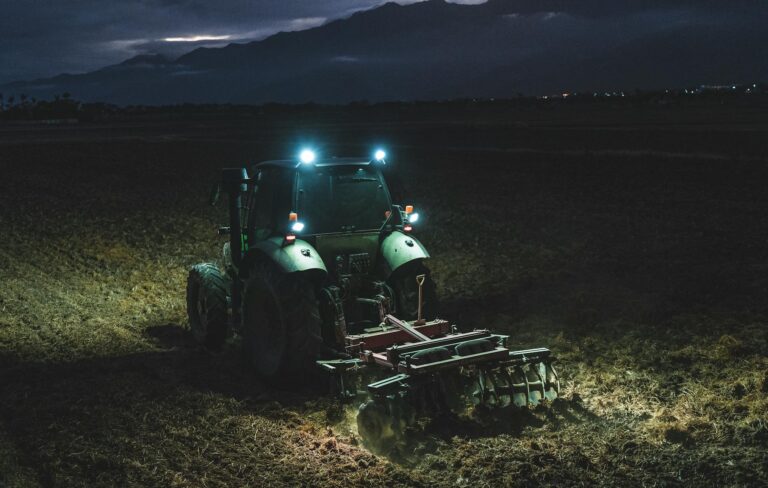
The job is to light a wide area ahead and around the tractor, out to roughly 20 to 30 m. A pair of front flood lamps of about 3,000 effective lumens each, with a 60 degree beam, gives roughly 35 lux each at 10 m and around 9 lux each at 20 m on the beam centre, more where the beams overlap. That is enough to see the ground, the tramlines and any obstacles. Choose 5,000K to 6,000K and CRI around 70 to 80.
Hitching and Rear Implement Work
The job is close range, 2 to 6 m, over a wide area. A wide flood lamp of 2,000 effective lumens with a 100 degree beam gives roughly 100 lux at 3 m. That is comfortable for coupling hydraulics and the PTO shaft. Two lamps, one each side, cut shadows.
Reaching the End of a Sprayer Boom
The job is to see the boom end and spray pattern 12 to 18 m out to the side. A spot or narrow combo lamp is the right tool. A 2,500-lumen lamp with a 20 degree beam has a peak intensity of roughly 26,000 cd, giving a little over 100 lux at 15 m. A flood lamp of the same output would give a small fraction of that at the boom tip.
Loader Work in the Yard
The job is to light the bucket and the heap 3 to 10 m ahead, with the arms raised and lowered. A combo beam of about 2,500 lumens works well because it keeps some light in the bucket when it is high and spreads light across the heap. Aim it slightly lower than for field work so it does not dazzle anyone on the yard.
Lambing Shed or Calving Pen Checks
The job is close inspection under a roof. A wide flood lamp of 1,500 to 2,500 lumens at 4,000K to 5,000K with a CRI of 80 or above shows colours naturally without the harsh glare of a high-kelvin lamp in a confined space.
How to Read a Work Light Spec Sheet
| Figure | What a good spec sheet shows | Warning sign |
|---|---|---|
| Lumens | Effective or measured lumens | Only “raw” or unexplained lumens, or a figure far above similar-sized lamps |
| Beam | Pattern name and beam angle | No beam pattern given |
| Lux or candela | Lux at a stated distance, or peak candela | Not given at all |
| Colour temperature | A kelvin figure, typically 5,000K to 6,500K | Very high kelvin presented as “brighter” |
| CRI | A stated figure, ideally 70 or above | Not stated (common, but worth asking for livestock use) |
| Power | Watts and voltage range | Wattage used as a brightness claim |
| Approvals | IP67 or IP69K, UNECE R10 EMC | No IP rating or EMC approval |
Watts measure power used, not light produced, and “equivalent to a 100W halogen” is a marketing comparison rather than a measurement. Compare effective lumens and beam angle first. Browse our LED work lamps and tractor LED work lights, or read best LED work lights for tractors for how to choose by job.
Frequently asked questions
What is the difference between lumens and lux?
Lumens measure the total light a lamp produces. Lux measures the light falling on each square metre of a surface at a particular distance. The same lumens give high lux in a narrow spot beam and low lux in a wide flood, and lux falls to a quarter each time the distance doubles.
What is the difference between raw lumens and effective lumens?
Raw lumens are the theoretical output of the LED chips under ideal lab conditions. Effective lumens are the measured light leaving the finished lamp after losses from heat, optics and the driver. Effective lumens are lower and are the honest figure to compare lamps by.
What colour temperature is best for LED work lights?
Around 5,000K to 6,000K suits most field and tractor work, giving crisp light close to daylight. Warmer light around 3,000K to 4,500K produces less glare in rain, fog and dust, and suits sheds and livestock areas. Above about 6,500K the light turns blue and increases glare.
Is a flood or spot beam better for tractor work lights?
A flood beam is better for most tractor work because it lights a wide area around the machine. A spot beam reaches much further but lights only a narrow strip, so it suits jobs such as lighting a sprayer boom end. A combo beam mixes both for front and loader work.
Are more lumens always better?
No. A lamp with more lumens but the wrong beam can light the job worse than a smaller lamp with the right beam. Too much output close to the tractor also causes glare off dust and rain. Match the beam to the distance, then choose enough effective lumens for the area.