Tractor Road Legal Lights: The Minimum Lighting Kit for Irish Roads
In this guide
- Why Road Legal Lighting Matters
- The Law Behind Tractor Road Legal Lights
- The Full Lighting System: Every Tractor on the Road
- Older Tractors: The Daylight-Only Exemption
- Fast Tractors Over 40 km/h
- Amber Beacon Rules for Tractors
- Work Lights on the Road
- Trailer and Implement Lighting
- Tractor Road Legal Lights: The Checklist
- Summary
Tractor road legal lights are the set of lamps a tractor must carry to drive legally on a public road in Ireland. The Irish rules are simpler than the UK’s, and stricter. Since 1 January 2016, every tractor and self-propelled agricultural machine must have a full lighting system (side lamps, headlamps, rear lamps, stop lamps, direction indicators, a flashing amber beacon and number plate lighting) fitted and working at all times, whatever its speed. The rules are in the Road Traffic (Lighting of Vehicles) Regulations 1963, as amended by S.I. No. 249 of 2014. This article sets out the full kit, the one exemption for older tractors, the beacon rule, work lights, trailers and implements, with a printable checklist table at the end so you can confirm your tractor has every light it needs before pulling onto the road.
Why Road Legal Lighting Matters
A tractor without the correct lights is committing an offence and creating a serious hazard. Tractors travel at 10 to 40 km/h (or more for fast tractors) on roads where other vehicles approach at 80 or 100 km/h. That speed difference gives a car driver very little time to react, and in poor visibility or at night, a tractor without working lights is practically invisible.
Missing lamps carry a €60 fixed charge, and in the event of a collision, inadequate lighting can shift liability. A following driver who sees a red rear lamp at 200 metres has roughly 7 seconds of reaction time at 100 km/h. Without that lamp, the reaction window drops to the point where avoidance may not be possible.
The Law Behind Tractor Road Legal Lights
The Road Traffic (Lighting of Vehicles) Regulations 1963 (S.I. No. 189 of 1963), as amended, are the main Irish regulations governing vehicle lighting. They set out which lamps vehicles must carry, the colours those lamps must show and how they may be used.
For tractors, the key amendment is S.I. No. 249 of 2014, in force since 1 January 2016. It overhauled agricultural vehicle lighting in one go, alongside new rules on braking, plating and speed discs. The RSA calls the whole package the “Revised Standards for Agricultural Vehicles”.
The big difference from the UK is that Irish requirements do not scale with design speed. A UK guide will tell you a 40 km/h tractor does not need stop lamps or main beam. That is not the position here. In Ireland, a 30 km/h tractor and a 60 km/h tractor need the same full lighting system. The only exemption is for older tractors used solely in daylight (covered below), and even then any lights that are fitted must work.
For the full scope of agricultural vehicle lighting law, including trailers, self-propelled machinery and implements, see the pillar guide.
The Full Lighting System: Every Tractor on the Road
Every tractor and self-propelled agricultural machine driven on a public road in Ireland must have:
- Side lamps (white to the front)
- Headlamps (white, dipped and main beam)
- Rear lamps (red)
- Stop lamps (red)
- Direction indicators (amber, front and rear)
- A flashing amber beacon
- Number plate lighting (the legal term is “identification mark lighting”)
Since 1 January 2016 this full system must be in place at all times, not just during lighting-up hours. Lighting-up hours run from half an hour after sunset to half an hour before sunrise, but for a post-1980 tractor that distinction matters less, because the lamps must be fitted and working whenever the tractor is on the road.
Side lamps and rear lamps make the tractor visible to other road users. Headlamps light the road ahead, with dipped beam used whenever there is other traffic about. Indicators signal turns, which matters on roads where a slow tractor is being overtaken often. Stop lamps warn following traffic that the tractor is slowing; at 30 km/h with a car closing at 100 km/h, a driver behind needs that warning straight away.
Most modern tractors, such as the John Deere 6000 series, Case IH Maxxum range, New Holland T5 series, John Deere 6R, Massey Ferguson 5S or Fendt 300 Vario, leave the factory with all of these lamps fitted, and many come with a beacon mount on the cab roof. After years of field work, vibration and corrosion, the lamps need regular checking. The obligation falls on the driver to confirm they work before every road journey.
Browse the full range of tractor rear lamps at Agri Lighting for direct replacements and universal options.
Older Tractors: The Daylight-Only Exemption
Under S.I. No. 249 of 2014, tractors, machinery and their trailers manufactured or first registered before 1 January 1980 are exempt from the full lighting system if they are used only in daylight. Current RSA guidance describes this as vehicles manufactured or first registered 30 years ago, so the two wordings differ. If you are relying on the exemption, check the current position with the RSA.
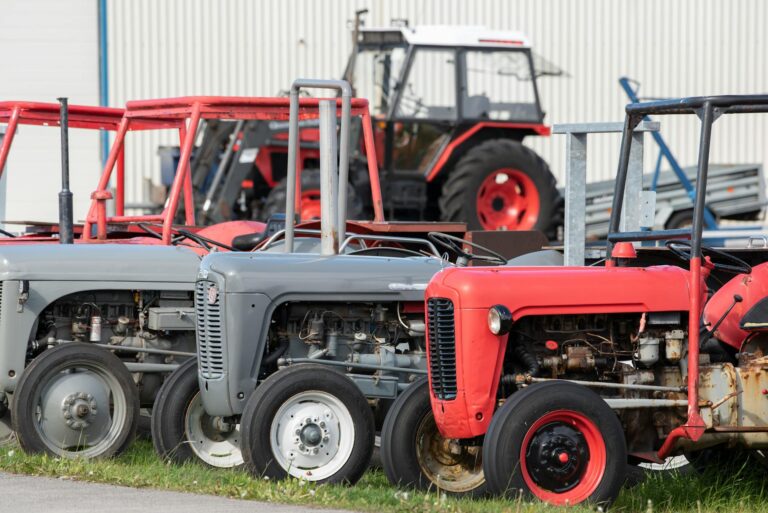
Many older tractors, such as the Massey Ferguson 135, David Brown 990 or Ford 3000, fall into this category. Three points to remember:
- The exemption only covers daylight use, meaning outside lighting-up hours. Out after dark, the tractor needs proper lights.
- Any lights that are fitted must work. If an older tractor has indicators fitted, those indicators must function correctly.
- The amber beacon exemption is worded separately, for vintage tractors used solely for vintage rallies or display. An older tractor doing farm work on the road should carry a beacon.
Fast Tractors Over 40 km/h
A fast tractor is a wheeled category T tractor with a maximum design speed over 40 km/h. Its lighting requirement is the same full system as any other tractor. What is different is testing.
Since 20 May 2018, fast tractors used for non-exempt work (such as local authority work, construction, quarrying or road works) must pass a CVRT test and display a Certificate of Roadworthiness. First test is at the 4th anniversary of first registration, then every 2 years. Lighting is checked at the test, and non-working lamps are failure items. Fast tractors used for agricultural, horticultural, forestry, farming or fishery activity within the State, mainly on the land where that work takes place, are exempt from testing but must still be roadworthy.
Fast tractors such as the JCB Fastrac, Fendt 900 Vario or John Deere 7R/8R series are designed for regular road use at higher speeds. Their lighting systems typically meet or exceed the requirements from the factory. The driver’s responsibility is to keep every lamp working.
Tractors first registered on or after 1 January 2016 must also carry a speed disc at the rear showing the design speed in km/h. Older tractors need one only if capable of more than 40 km/h.
Amber Beacon Rules for Tractors
This is where Ireland differs most from the UK. Every agricultural tractor and self-propelled agricultural machine must have a flashing amber beacon fitted, and it must be switched on whenever the vehicle is on a public road. That applies regardless of speed, width or road type. The only exception is vintage tractors used solely for vintage rallies or display.
The beacon must meet the Irish mounting rules (Article 52(18), as replaced by S.I. No. 639 of 2020):
- Position. Where possible on the roof, on the vehicle’s centre line, so it gives a clear all-round warning.
- Height. No part of the illuminated surface less than 1.27 metres from the ground. On most tractors this means the cab roof or a dedicated beacon pole.
- Size and power. The light-emitting area within a 230 mm square, and no more than 36 watts for an amber lamp.
The beacon must flash, not show a steady light, and an ECE R65 approved beacon is the safe choice. An LED beacon sits well within the 36 W limit.
The amber beacon is not a substitute for the other lamps. It adds a highly visible warning on top of them.
Browse the range of tractor beacons at Agri Lighting for magnetic, bolt-on and pole-mount options.
Work Lights on the Road
RSA guidance is clear: work or ploughing lamps may be used on private land but must be switched off before using the public road. Article 49(6) of the 1963 Regulations says ploughing lamps shall not be used while the vehicle is on a public road. This is a common point of confusion, because work lights are fitted to almost every modern tractor and are used daily in the field.
A forward-facing work light on a public road can dazzle oncoming drivers with the same blinding effect as full beam headlights. A rear-facing work light is worse: the RSA says rear white lights are banned on the road, because they can look like an approaching vehicle. A driver behind may think the tractor is coming towards them, which on a narrow road can end in a collision.
Before joining the road, switch off all work lights. If the tractor has manually adjustable work lights, fold them down or turn them away from the direction of travel. Some tractors have a road mode that automatically disables work lights when the road lights are switched on. If yours does not, make it part of your pre-road check.
The lamps described in this article are the ones that replace work lights on the road: side and rear lamps for visibility, headlamps for lighting the road, indicators for signalling, stop lamps for braking, and the beacon as a warning.
Trailer and Implement Lighting
Agricultural trailers and interchangeable towed equipment must carry their own side lamps, rear lamps, stop lamps, direction indicators and number plate lighting. Towed equipment without its own lights (balers, sprayers, rakes and similar) needs lights only if it hides the tractor’s front or rear lamps or reflectors, and in that case a lighting board must be fitted.
This applies in several common scenarios:
- Towing a trailer. The trailer’s own rear lamps, stop lamps, indicators and number plate light take over from the tractor’s at the back. These must work and must be connected through the towing socket.
- Towing a wide implement. A plough, mower or cultivator that hides the tractor’s rear lamps needs a lighting board or lamps fitted to the implement itself.
- Carrying a rear-mounted implement. A bale spike or attachment that blocks the tractor’s rear lamps needs a lighting board or lamps fitted to the implement or above it.
- Front loaders. The RSA advises that front loaders, forks and other front-mounted attachments should be lowered and faced down on the road, because raised forks are a dangerous projection.
Longer combinations need more. Where a tractor and trailer combination is over 10 metres long, the trailer needs side marker lamps. Agricultural trailers over 3,500 kg design gross vehicle weight also need rear reflective markings, side reflective markings over 10 m and a rear “LONG VEHICLE” marking over 13 m (slurry tankers, spreaders and grain chaser bins are exempt from these markings).
The rear of whatever is furthest back must show the correct lights. The beacon stays on the tractor cab roof, switched on.
For detailed guidance on tractor lighting regulations, including trailer-specific requirements, see the dedicated guide.
Tractor Road Legal Lights: The Checklist
This table shows every lamp required on Irish roads since 1 January 2016. Print it, laminate it and keep it in the cab.
| Light | Tractor or self-propelled machine | Older tractor (pre-1980 or 30+ years), daylight only | Agricultural trailer or towed equipment | Towed equipment without lights |
|---|---|---|---|---|
| Side lamps | Required | Exempt (fitted lamps must work) | Required | Lighting board if tractor lamps are hidden |
| Headlamps (dipped and main beam) | Required | Exempt (fitted lamps must work) | Not applicable | Not applicable |
| Rear lamps (red) | Required | Exempt (fitted lamps must work) | Required | Lighting board if tractor lamps are hidden |
| Stop lamps (red) | Required | Exempt (fitted lamps must work) | Required | Lighting board if tractor lamps are hidden |
| Direction indicators (amber) | Required | Exempt (fitted lamps must work) | Required | Lighting board if tractor lamps are hidden |
| Number plate lighting | Required | Exempt (fitted lamps must work) | Required | Lighting board if tractor lamps are hidden |
| Flashing amber beacon | Required, on whenever on a public road | Fit one; only rally and display vintage tractors are exempt | Not applicable (beacon on the tractor) | Not applicable (beacon on the tractor) |
| Side marker lamps | Not applicable | Not applicable | Required on the trailer if combination over 10 m | Not applicable |
Notes on the table:
- All the time, not just at night. For post-1980 tractors, trailers and self-propelled machines, the full system must be fitted and working at all times on the road, not only during lighting-up hours.
- Older tractors. The daylight-only exemption applies only outside lighting-up hours, and any lights that are fitted must work. Check the current cut-off with the RSA.
- Rear fog lamps. Not on the Irish obligatory list for tractors. If one is fitted, keep it working and use it only in dense fog or falling snow.
- Work lights. Not listed because they must be off on the public road.
- Reflectors and markings. Keep red rear reflectors fitted and clean. Agricultural trailers over 3,500 kg design gross vehicle weight need rear reflective markings, plus side markings over 10 m and “LONG VEHICLE” markings over 13 m.
Summary
Tractor road legal lights in Ireland are one full kit, not a ladder of speed tiers. Since 1 January 2016, every tractor and self-propelled agricultural machine must carry side lamps, headlamps, rear lamps, stop lamps, indicators, a flashing amber beacon and number plate lighting, fitted and working at all times. Trailers and towed equipment need their own lamps, or a lighting board where they hide the tractor’s. The beacon must be on whenever the tractor is on a public road. Work lights must be off on the road. Older tractors used only in daylight are the one exemption. Missing lamps carry a €60 fixed charge, and the Gardaí enforce the rules at the roadside.
Use the checklist table above as your pre-road reference. Check every lamp, and the beacon, before every journey. A blown bulb takes 5 minutes to replace. A collision caused by an unseen tractor takes a lifetime to recover from.
Browse tractor rear lamps and tractor beacons at Agri Lighting for replacements, upgrades and universal fitment options, with free delivery to Ireland on orders over €150.