Tractor Reversing Lights: Fitment, Rules, and Best Options
In this guide
- What a Tractor Reversing Light Is
- Irish Rules for Tractor Reversing Lights
- Where to Mount a Tractor Reversing Light
- Reversing Light Bulb Types and Sizes
- LED Reversing Light Upgrade
- Reversing Light Wiring and the Reverse Switch
- Common Tractor Reversing Light Faults and Fixes
- Choosing the Right Tractor Reversing Light
- Frequently Asked Questions
A tractor reversing light is a white rear-facing lamp that illuminates the area behind the tractor when reverse gear is engaged. Irish road law allows not more than 2 reversing lamps, white or yellow and facing rearward, and they may only be used when reversing. Modern tractors run reversing lights as standard. Older machines often have one fitted as an aftermarket accessory or rely on the work-light cluster instead. This guide covers what a tractor reversing light does, the Irish rules that govern its use, mounting positions, bulb types, the LED upgrade path, wiring, and common faults.
What a Tractor Reversing Light Is
A tractor reversing light is a rear-mounted white lamp that switches on automatically when the operator selects reverse gear. The lamp lights the ground and the area immediately behind the tractor to make reversing safer in poor light. The same lamp acts as a signal to anyone behind the tractor that the machine is about to move backwards.
The reversing light differs from a work light in three ways. The reversing light is white. The reversing light may only be used for reversing. The reversing light is limited in number by Irish road law. A work light, in contrast, is switched manually, but on a road it may only be lit to light a working area, accident, breakdown or works near the vehicle.
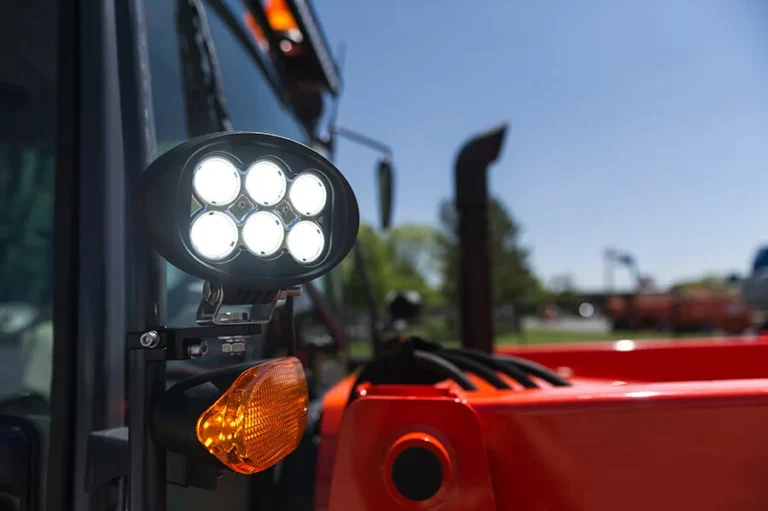
Tractor reversing lights are usually fitted in pairs on the rear cab pillars or on the rear cab roof. Single-lamp installations are also common on older or compact tractors, mounted to the rear fender, the tow bracket, or the linkage area. The lamp body is a sealed plastic or alloy housing with a clear lens and either a bulb holder or an integrated LED module.
For an overview of every lamp fitted to a working tractor, see The Complete Guide to Tractor Lighting.
Irish Rules for Tractor Reversing Lights
In Ireland, reversing lamps are covered by the Road Traffic (Lighting of Vehicles) Regulations 1963, as amended (Articles 41 and 49). The regulations permit reversing lights on agricultural tractors used on the road, subject to these rules.
The four rules to follow.
- Colour. The lamp must show white or yellow light. White is the normal choice on tractors. Other colours are not permitted.
- Number. Not more than 2 reversing lamps. A single lamp is legal. Lamps must face rearward.
- Approval. RSA guidance is to fit like-for-like, type-approved lamps that carry an E or e mark.
- Use and switching. The lamp must only be lit when reversing. Wiring it through the reverse switch is the simplest way to make sure of this. RSA guidance also points out that white lights to the rear are banned on the road because they can look like an approaching vehicle, so a reversing lamp left on while driving forward is a problem.
The regulations apply to lamps fitted on a tractor that is driven on a public road. Off-road use is not restricted in the same way, but a tractor that operates on both road and field is subject to the road rules whenever it returns to the public road.
A reversing light is not on the list of obligatory lamps for a tractor in Ireland. Since 1 January 2016 a tractor must have side lamps, headlamps, rear lamps, stop lamps, direction indicators, a flashing amber beacon and number plate lighting, but not a reversing lamp. The obligatory list for agricultural trailers does not include one either. Newer type-approved road trailers usually have reversing lamps fitted as standard, and any reversing lamp that is fitted must work and comply.
The maintenance rule. Any lamp fitted to a road-going tractor, including a reversing lamp, must be clean, unobscured, and in good working order. Gardaí can stop a tractor with faulty lights, and a fast tractor tested under the CVRT will fail with a non-working lamp.
For the full legal framework, see tractor lighting regulations and the broader vehicle lighting regulations reference.
Where to Mount a Tractor Reversing Light
Reversing-light mounting positions on a tractor fall into 4 standard locations. The choice of location depends on cab age, rear visibility, and whether the tractor pulls implements that block lower mounting points.
The four standard mounting positions.
- Rear cab roof. The lamp sits on the cab roof above the rear window, often on a swept mounting bar or alongside the work-light pod. Roof mounting gives the widest spread on the ground behind the tractor. Roof mounting is the standard position on modern John Deere, New Holland, and Massey Ferguson cabs.
- Rear cab pillar. The lamp clamps to the cab pillar or to a dedicated bracket on the rear corner. This is the typical OEM position on tractors from 2005 onward.
- Rear fender. The lamp bolts to the inner face of the rear mudguard, just above or beside the tail lamp. Fender mounting is common on older tractors built before 2000.
- Linkage or drawbar area. The lamp mounts low on the rear of the chassis, near the three-point linkage or the drawbar. Linkage mounting suits tractors used mainly for trailer work, where the lamp lights the coupling point.
Mounting position affects beam coverage. A roof-mounted lamp lights an area 2 to 6 metres behind the tractor with a broad spread. A fender-mounted lamp lights an area 0.5 to 3 metres behind the tractor, biased toward the wheel side. A linkage-mounted lamp lights the coupling and the trailer drawbar specifically.
Mounting hardware. The reversing lamp typically attaches with 1 or 2 M6 or M8 bolts. The lamp body is supplied with a steel or stainless bracket that bolts to a flat surface. For roof-mounting on a tractor without a pre-drilled hole, fit a universal clamp-on bar to the cab gutter rather than drilling the cab structure.
For wider guidance on lamp positioning, see Mounting Positions for Tractor Lights.
Reversing Light Bulb Types and Sizes
Tractor reversing-light bulbs fall into 3 common types: the BA15s P21W single-contact bulb, the W21W wedge bulb, and the festoon bulb. Each fits a specific lamp body. The wrong bulb will not seat correctly and will fail within hours.
The three common bulb types.
- BA15s P21W. A single-contact bayonet bulb rated at 21 watts, 12 volts. The bayonet fits a single pin slot. This is a very common reversing-light bulb on tractors.
- W21W. A glass wedge bulb rated at 21 watts, 12 volts. The wedge base pushes directly into a moulded holder. W21W is found in many newer lamp designs.
- Festoon C5W and C10W. A tube-shaped bulb with metal end caps that springs into a clip holder. Festoon bulbs appear on some compact tractor and older European tractor reversing lamps. The C5W is rated 5 watts and the C10W 10 watts.
Bulb voltage. Most modern tractors run a 12-volt electrical system, but some larger tractors and older European models run 24-volt systems. Match the bulb voltage to the tractor system. A 12-volt bulb on a 24-volt circuit fails in seconds. A 24-volt bulb on a 12-volt circuit lights dimly and never reaches full output.
Bulb wattage. Stick with the bulb the lamp was designed for, which is normally the standard 21-watt P21W or W21W. Avoid fitting higher-wattage bulbs sold as upgrades, because they change the lamp from its approved design and can overheat and melt the lamp body.
Bulb life. A P21W or W21W is a standard filament bulb, not a halogen. A reversing lamp is used for short periods, so a bulb often lasts several years in practice. Failure is usually filament breakage from vibration rather than burnout.
For a complete reference, see Vehicle Bulb Types Explained.
LED Reversing Light Upgrade
An LED reversing light replaces the standard halogen bulb or sealed halogen lamp with a light-emitting diode equivalent. The upgrade improves brightness, lowers current draw, and lasts 10 to 30 times longer than a halogen bulb. The upgrade path takes 2 forms: a drop-in LED bulb that fits the existing lamp body, or a complete LED lamp unit that replaces the housing.
LED reversing light benefits.
- Brighter ground coverage. A 21-watt P21W bulb is rated at around 460 lumens. A good LED reversing lamp with proper optics puts more usable light on the ground behind the tractor.
- Lower current draw. An LED reversing lamp draws 0.5 to 2 amps on a 12-volt system, compared with 1.75 amps for a 21-watt halogen.
- Longer service life. A quality LED lamp typically lasts far longer than a filament bulb.
- Vibration resistance. Solid-state LEDs have no filament to break under tractor vibration.
LED reversing light trade-offs. Cheap LED bulbs can flicker on circuits that include a fault-monitoring relay. Cheap LED bulbs can interfere with AM radio reception. Cheap LED bulbs can fail EMC compliance and cause GPS or auto-steer drift on modern tractors. For these reasons, fit only LED reversing lamps that carry the R10 EMC approval marking and an ECE type-approval mark for road use.
The drop-in bulb route. Buy a P21W or W21W LED replacement bulb rated for 10 to 30 volts. Remove the filament bulb. Insert the LED. Test the operation in reverse gear. A drop-in upgrade takes 5 to 10 minutes per lamp and costs roughly €10 to €30 per bulb. Note that a lamp’s approval covers the bulb it was designed for, so for road use a complete E-marked LED lamp is the safer route.
The full lamp route. Buy a complete LED reversing lamp with an integrated driver. Remove the original lamp body. Bolt the new lamp into the same mounting holes. Connect the 2 wires to the reverse circuit. A full lamp upgrade takes 20 to 40 minutes and costs roughly €30 to €105 per lamp.
For a deeper comparison of the technology, see LED vs Halogen Tractor Lights and the related LED Headlamp Conversions guide.
Reversing Light Wiring and the Reverse Switch
Tractor reversing-light wiring runs from a reverse switch on the gearbox to the lamp at the rear of the tractor. The reverse switch closes the circuit only when reverse gear is selected, which keeps the lamp off unless the tractor is reversing.
The reversing-light circuit components.
- Reverse switch. A normally-open switch mounted on the gearbox or transmission housing. The switch closes when the reverse selector fork moves into position. Some tractors use a pressure switch on a hydraulic reverse circuit instead of a mechanical switch.
- Live feed. A 12-volt or 24-volt feed from the ignition-switched supply, fed through a 5-amp or 7.5-amp fuse.
- Loom wire. A single-core 1.0 to 1.5 mm² cable runs from the reverse switch to the rear of the tractor.
- Lamp earth. The lamp body earths to the chassis through the mounting bracket or through a dedicated 1.0 mm² earth wire.
Wiring a reversing lamp from scratch. Take the live feed from an ignition-switched terminal, not directly from the battery. Pass the live through a 5-amp inline fuse. Connect the fuse output to the reverse switch input terminal. Take the switch output to the rear of the tractor in a single-core cable. Connect the cable to the lamp positive. Earth the lamp negative to a clean chassis point or directly back to the battery negative.
Wire size. A single 21-watt halogen bulb draws 1.75 amps on 12 volts. A 1.0 mm² cable handles this comfortably over runs up to 5 metres. For runs longer than 5 metres, or for 2-lamp installations, step up to 1.5 mm² cable to limit voltage drop.
Common wiring errors. Wiring the lamp to a permanent live so it stays on with the ignition off. Fitting a separate manual switch on the dashboard, which makes it easy to leave a white rear lamp lit on the road, where it must only be used when reversing. Earthing the lamp to a painted bracket, which gives a high-resistance earth and causes flicker.
For the broader wiring topic, see How to Wire Tractor Lights and How to Wire Tractor Lights with a Relay.
Common Tractor Reversing Light Faults and Fixes
Tractor reversing-light faults fall into 4 recurring categories: no light at all, lamp on permanently, flickering output, and corroded contacts. Each fault has a clear test and a fix that most operators can complete in under 30 minutes.
Fault 1, no light at all. Symptoms. The lamp does not light when reverse is selected. Cause and test. Check the fuse first. Check the bulb next by swapping with a known-good bulb. Check the reverse switch by bridging the two switch terminals with a jumper wire while a helper observes the lamp. Check the earth with a multimeter set to resistance. Fix. Replace the blown fuse, replace the failed bulb, replace the reverse switch, or clean the earth point.
Fault 2, lamp on permanently. Symptoms. The reversing lamp stays lit in any gear, including forward and neutral. Cause and test. The reverse switch is stuck closed. Unscrew the switch from the gearbox. Check the plunger movement. A stuck plunger means a failed switch. Fix. Replace the reverse switch. Most reverse switches are a screw-in fitting that takes 5 to 10 minutes to swap.
Fault 3, flickering output. Symptoms. The lamp flickers, dims, or pulses when reverse is selected. Cause and test. A bad earth is the most common cause. Test the resistance from the lamp body to the battery negative. A reading above 0.3 ohms means a corroded earth. Fix. Clean the earth point to bare metal, smear with conductive grease, refit with a new bolt and Nyloc nut. For a related deep dive on this symptom, see What Causes Tractor Lights to Flicker.
Fault 4, corroded contacts. Symptoms. The bulb sits in the holder but the lamp lights intermittently or not at all. Cause and test. Years of moisture in the lamp body corrode the bulb contacts and the holder springs. Fix. Remove the bulb. Spray the holder contacts with electrical contact cleaner. Burnish the contacts with a small wire brush or a folded piece of fine wet-and-dry paper. Refit the bulb. If the holder is badly corroded, replace the whole lamp unit.
Prevention. Use a small amount of dielectric grease on the bulb base before fitting. Check the lamp seal and replace the rubber gasket if it has hardened. Hose the rear of the tractor with fresh water after working in a salty or slurry-rich environment to slow corrosion.
For the diagnostic flow that covers every lighting fault on a tractor, see How to Troubleshoot Tractor Lighting Problems.
Choosing the Right Tractor Reversing Light
The right tractor reversing light depends on 4 factors: tractor age and existing wiring, mounting space available, single-lamp or twin-lamp setup, and budget.
Tractor age. A modern tractor (post-2010) usually has a factory reversing lamp, so the question is replacement rather than fitment. Match the original lamp type. For a tractor without a factory reversing lamp, add a single LED unit on a universal bracket.
Mounting space. A flat panel on the rear of the cab allows a compact rectangular LED lamp 80 to 120 mm wide. A cab roof allows a wider lamp with broader beam spread. A fender allows a small round lamp 60 to 90 mm in diameter.
Single-lamp or twin-lamp. A single lamp is enough for tractors under 100 hp working on yard and small fields. A twin-lamp setup is standard on tractors over 150 hp and on tractors used with wide implements, because the second lamp lights the implement coupling area.
Budget. A 21-watt halogen reversing bulb costs roughly €2 to €6. A drop-in LED bulb costs roughly €10 to €30. A complete LED reversing lamp costs roughly €30 to €105. A twin-lamp LED kit with brackets and wiring costs roughly €70 to €210.
Browse the reverse lamp product range for halogen, LED, and hybrid options that match common tractor cab fitments.
Frequently Asked Questions
Are reversing lights legal on tractors? Yes. Irish law permits not more than 2 reversing lamps on a tractor used on the road. They must be white or yellow, face rearward and be used only when reversing. Fit type-approved lamps with an E or e mark.
Do tractors need reversing lights in Ireland? No. The reversing lamp is not on the obligatory list for a tractor or an agricultural trailer. If one is fitted, it must work.
How do you wire a tractor reversing light? Take a 5-amp fused live feed from the ignition-switched supply to the reverse switch on the gearbox. Run a single-core cable from the switch output to the lamp positive. Earth the lamp negative to a clean chassis point.
What bulb does a tractor reversing light take? Most modern tractors take a P21W BA15s bayonet bulb or a W21W wedge bulb, both rated at 21 watts, 12 volts. Some older or compact tractors take a festoon C5W or C10W. Check the existing bulb before ordering.
Can I fit LED reversing lights to my tractor? Yes. Drop-in LED replacement bulbs fit the existing lamp body and cost roughly €10 to €30. Fit only EMC-approved LEDs (R10 marking) to prevent interference with GPS, radio, and auto-steer systems on modern tractors.