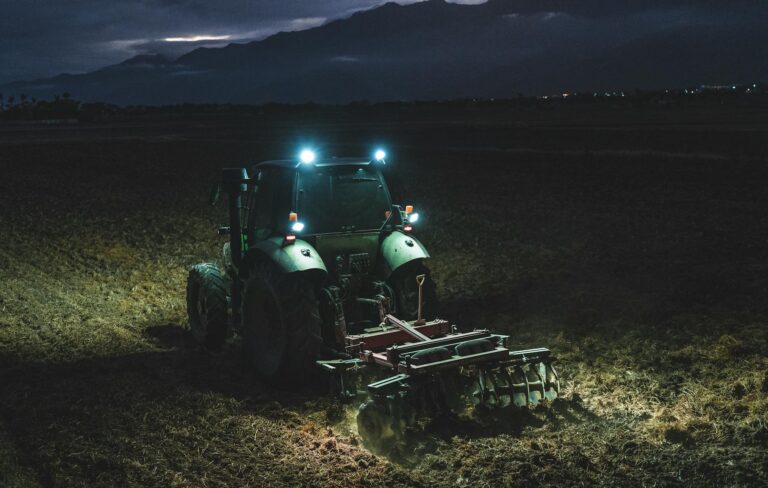
Best LED Work Lights for Tractors 2026: How to Choose
In this guide
- What Makes a Good LED Work Light for a Tractor
- Best for the Cab Roof: Wide Flood Lamps
- Best for Rear Implement Work: Flood or Combo
- Best for Loader Work: Forward Reach Without Glare
- Best for Reversing: Wide, Low Flood
- Best for Compact Tractors: Small, Low-Draw Lamps
- Lumens and Beam by Job: Quick Reference
- 12V or 24V: Choosing the Right Voltage
- How to Read a Work Light Spec Sheet Honestly
- LED vs Halogen for Tractor Work Lights
- Where to Buy Tractor LED Work Lights
- Frequently asked questions
The best LED work lights for a tractor are the ones matched to the job: wide flood lamps of roughly 2,000 to 5,000 effective lumens for the cab roof, flood or combo lamps for rear implement work, a tighter beam for loader reach, and compact lamps for small tractors. Look for IP67 or IP69K sealing, ECE R10 EMC approval, multi-voltage 9 to 32V input and a die-cast aluminium housing.
This guide is a buying guide, not a product test. We have not lab-tested lamps, and we do not rank brands. Instead it sets out what each job on a tractor needs, which specifications actually tell you whether a lamp will do that job, and how to read a spec sheet without being caught out by inflated figures. Use it to narrow the choice, then compare lamps in our LED work lamps range against the checklist below.
What Makes a Good LED Work Light for a Tractor
A good tractor work light puts the right amount of light in the right place, survives the conditions on a farm, and does not interfere with the tractor’s electronics. Six specifications decide that.
| Specification | What to look for | Why it matters |
|---|---|---|
| Effective lumens | A measured output figure, not “raw” or “chip” lumens | Effective lumens are what leaves the lens. Raw lumens can be far higher than the light you get. |
| Beam pattern | Flood, wide flood, spot or combo, ideally with a stated beam angle | The same lumens spread wide or narrow light completely different areas. |
| Ingress protection | IP67 minimum, IP69K if the machine is pressure-washed | Water and dust kill LED drivers. IP69K is tested against high-pressure, high-temperature spray. |
| EMC approval | UNECE Regulation 10 (R10) mark on the lamp or label | Poorly suppressed LED drivers can cause radio, DAB and GPS interference. |
| Voltage | Multi-voltage, typically 9 to 32V or 10 to 30V | One lamp fits 12V tractors and 24V plant, and copes with voltage swings. |
| Housing and mounting | Die-cast aluminium body, stainless or coated bracket, sealed connector or quality cable tail | The housing is the heat sink. A thin body runs the LEDs hot and shortens their life. |
Two more details separate a lamp that lasts from one that does not: a breathable vent membrane (to stop condensation without letting water in) and a pre-fitted sealed connector such as a Deutsch DT. Our guides to IP67 vs IP69K work lights and EMC compliance on modern tractors go into both in more depth.
Best for the Cab Roof: Wide Flood Lamps
The best cab roof work lights are wide flood lamps that light a broad area around the tractor without hot spots. The roof is the highest mounting point on most tractors, so a wide beam from there covers the field ahead, the headland and the area around the wheels.
- Output: about 2,000 to 5,000 effective lumens per lamp is a sensible range for most tractors. Fit in pairs, balanced left and right.
- Beam: flood or wide flood, roughly 60 degrees and wider. Combo lamps suit tractors that also need some forward reach.
- Mounting: check whether your cab has factory work light positions and the hole spacing. Many replacement lamps are made to fit common factory brackets.
- Colour: cool white around 5,000K to 6,500K is standard and works well for field work.
Four roof lamps (2 front, 2 rear) is a common setup. More is not automatically better: overlapping beams waste power, and lamps aimed too high throw glare back off dust, rain and spray.
Best for Rear Implement Work: Flood or Combo
The best rear work lights light the hitch, the implement and the ground behind it, so the operator can see the drill coulters, the plough or the bale chamber without twisting round to guess. Rear lamps work harder than front ones because they light a moving, dusty area at a shallow angle.
- Output: about 2,500 to 5,000 effective lumens per lamp for a full-width implement.
- Beam: flood for close work at the hitch, combo or a narrower flood to reach the far end of a wide implement.
- Position: rear cab roof lamps aimed down and back, with fender or mudguard lamps for the linkage area.
- Protection: IP69K is worth having here because rear lamps take the most mud and the most pressure washing.
For long implements such as a wide drill or a sprayer boom, a pair of lamps on the implement itself often does more than extra lamps on the tractor.
Best for Loader Work: Forward Reach Without Glare
The best loader work lights put light into the bucket or onto the tines and the stack face in front of the loader, not just onto the bonnet. Loader work needs some reach and needs the light to stay useful when the arms are raised.
- Output: about 2,000 to 4,000 effective lumens per lamp.
- Beam: combo or a narrower flood. A pure spot is too narrow for loading.
- Position: front cab roof lamps aimed slightly lower than for field work, or lamps on the loader frame so they move with the arms.
- Glare: loader lamps are the ones most likely to dazzle traffic on a yard road or farm track, so they must be switched off before the tractor goes on the road.
Best for Reversing: Wide, Low Flood
The best reversing work lights are wide flood lamps mounted low at the rear, lighting the ground immediately behind the tractor and the hitch. Reversing to a trailer or into a shed needs a wide, even pool of light close in, not distance.
- Output: about 1,000 to 2,500 effective lumens is enough at close range.
- Beam: wide flood.
- Wiring: if the lamp is to come on automatically with reverse, it is acting as a reversing lamp and has to meet reversing lamp rules on the road. Most farm installs wire these as switched work lamps instead.
If you need a dedicated, road-approved reversing lamp, look for one approved as a reversing lamp rather than a work lamp.
Best for Compact Tractors: Small, Low-Draw Lamps
The best work lights for compact tractors are small flood lamps with a low current draw, because compact machines have smaller alternators, smaller batteries and limited mounting space on the ROPS frame or canopy.
- Output: about 800 to 2,500 effective lumens per lamp.
- Size: compact round or square housings that clamp to a ROPS bar or fit a small bracket.
- Current: check the total draw against the alternator output. LED lamps are far kinder to a small charging system than halogen.
- Connector: a sealed plug on a short tail makes removal easy if the frame folds down.
Our compact tractor work lights guide covers mounting and wiring on smaller machines.
Lumens and Beam by Job: Quick Reference
The table below is a starting point for choosing output and beam. The ranges are per lamp and use effective lumens. Conditions vary, so a contractor working long dusty nights may want the top of the range where a livestock farmer feeding in the yard will be happy at the bottom.
| Job | Effective lumens per lamp | Beam | Typical number |
|---|---|---|---|
| Cab roof, front field work | 2,000 to 5,000 | Flood or wide flood | 2 |
| Cab roof, rear implement | 2,500 to 5,000 | Flood or combo | 2 |
| Loader work | 2,000 to 4,000 | Combo or narrow flood | 2 |
| Reversing and hitching | 1,000 to 2,500 | Wide flood | 1 to 2 |
| Fender and side lighting | 1,000 to 2,500 | Wide flood | 2 to 4 |
| Compact tractor | 800 to 2,500 | Flood | 2 to 4 |
| Long reach (sprayer boom ends, combine headers) | 3,000 and above | Spot or combo | 2 |
For more on how the numbers relate, see work light lumens, lux and colour temperature explained.
12V or 24V: Choosing the Right Voltage
Almost all tractors run a 12V electrical system. Many HGVs, a lot of larger construction plant and military vehicles run 24V. A multi-voltage LED lamp, usually marked 9 to 32V or 10 to 30V, works on both, which is why it has become the standard choice.
- For a 12V tractor, any lamp marked 12V or multi-voltage fits. Browse 12V work lamps.
- For 24V machines, check the label shows 24V or a multi-voltage range that includes it. Browse 24V work lamps.
- A multi-voltage lamp makes sense if you run mixed machinery or move lamps between machines.
The voltage also affects the wiring. At 24V a lamp of the same wattage draws half the current, so fuses and cable can be smaller. The relay coil must match the system voltage either way.
How to Read a Work Light Spec Sheet Honestly
LED work light listings vary a lot in how honest their numbers are. These checks help you compare like with like.
Effective Lumens vs Raw Lumens
Raw lumens are the theoretical output of the LED chips added together, measured under ideal lab conditions. Effective lumens are the measured output of the finished lamp, after losses in the lens, the reflector and from heat. A lamp quoting only raw lumens will give noticeably less light than the headline suggests. If a listing does not say which, assume raw.
Watts Are Not Brightness
Watts measure power drawn, not light produced. Two lamps of the same wattage can produce very different amounts of light depending on LED efficiency and optics. Compare lumens, then use watts to work out current draw (watts divided by voltage).
Look for Approval Marks You Can Check
An R10 approval shows the lamp has been approved for electromagnetic compatibility on vehicles. On the label it appears as an E in a circle or rectangle with a country number, alongside an approval number that includes “10R”. “CE” alone does not cover vehicle EMC.
Check the Seal and the Cable
IP67 and IP69K should be stated as tested ratings. Look at how the cable enters the housing: a moulded gland or a sealed connector lasts; a bare cable through a rubber bung often lets water in after a season.
Check the Warranty Terms
A clear warranty from a seller with a real returns address you can send to from Ireland is worth more than a long warranty you cannot practically claim on.
LED vs Halogen for Tractor Work Lights
LED has replaced halogen for most new work light fitments because it gives more light per watt, far longer life, and much better resistance to vibration. A 55W halogen work lamp draws about 4.6A at 12V. An LED lamp with similar or greater useful output often draws well under half that, which leaves headroom on the alternator for more lamps or other electrical loads.
Halogen still has a place on vintage and restored tractors where original appearance matters, and as a low-cost bulb replacement in an existing lamp that is otherwise sound. For a new or upgraded setup, LED is the better choice.
Where to Buy Tractor LED Work Lights
We stock universal LED work lamps in flood, spot and combo patterns, plus replacement lamps for specific tractor makes. Start with tractor LED work lights if you are replacing a factory lamp, or the universal range for added lamps. Orders to the Republic of Ireland of €150 or more ship free from our Lincolnshire warehouse, and you can get 10% off your first order by signing up to our newsletter.
Frequently asked questions
What are the best LED work lights for a tractor?
The best LED work lights for a tractor are sealed to at least IP67 (IP69K if pressure-washed), carry UNECE R10 EMC approval, accept 9 to 32V, and have a die-cast aluminium housing. Choose wide flood lamps for the cab roof, flood or combo for the rear, and compact flood lamps for small tractors.
How many lumens do I need for tractor work lights?
Most cab roof work lights fall between about 2,000 and 5,000 effective lumens per lamp, fitted in pairs. Reversing and close work need less, about 1,000 to 2,500. Long-reach jobs such as sprayer booms use 3,000 lumens and above with a narrower beam.
Flood or spot for tractor work lights?
Flood is the right choice for most tractor work because it lights a wide area around the machine. Spot beams reach further but light a narrow strip, so they suit long-reach jobs only. A combo lamp mixes both and is a good compromise for loader and front work.
Do LED work lights interfere with tractor GPS or radio?
Poorly suppressed LED drivers can cause radio, DAB and GPS interference. Lamps approved to UNECE Regulation 10 have been tested for electromagnetic compatibility, which greatly reduces the risk. Check for the R10 approval before fitting lamps to a tractor with auto-steer.
Can I use tractor work lights on the road?
No. Work lights must not be used to light the road while driving. RSA guidance says work or ploughing lamps may be used on private land but must be switched off before you use the public road, and the Road Traffic (Lighting of Vehicles) Regulations 1963 say ploughing lamps shall not be used while the vehicle is on a public road. White lights showing to the rear are also banned on the road because they can look like an oncoming vehicle.