Tractor Lighting Law in Ireland: Every Light a Tractor Needs on the Road
In this guide
- Which regulations apply to tractor lights
- Why design speed matters less in Ireland
- Every light your tractor needs, lamp by lamp
- Amber beacons on every tractor
- Lighting-up hours and daytime use
- Trailers and implements
- Overhanging implements and projecting loads
- Work lights and other optional lamps
- What the Gardaí and RSA check
- Frequently asked questions
Tractor lighting law in Ireland is the Road Traffic (Lighting of Vehicles) Regulations 1963 (S.I. No. 189 of 1963), as amended, with the big agricultural update in S.I. No. 249 of 2014, which came into force on 1 January 2016. Every tractor and self-propelled agricultural machine used on a public road needs side lamps, headlamps, rear lamps, stop lamps, direction indicators, a flashing amber beacon and number plate lighting, and that full system must be in place at all times, not just at night.
That is the main difference from the UK, where the lamps a tractor needs depend on its design speed and age. In Ireland the list is the same for every post-1980 tractor, whatever its speed. This guide works through each lamp, then covers beacons, lighting-up hours, trailers, overhanging implements and what gets checked at the roadside. For what each type of lamp does and where it is fitted, see the complete guide to tractor lighting. This page is about the law.
Which regulations apply to tractor lights
The Road Traffic (Lighting of Vehicles) Regulations 1963 are the principal lighting rules in Ireland. They have been amended many times and are cited together as the Road Traffic (Lighting of Vehicles) Regulations 1963 to 2020. Article 9 lists the obligatory lamps, Article 41 sets lamp colours, Article 48 bans dazzling and misleading lamps, Article 49 controls how lamps are used and Article 52(18) covers warning beacons.
For farm machinery the key amendment is S.I. No. 249 of 2014. From 1 January 2016 it brought in amber beacons on tractors and self-propelled machines, lights at all times, trailer lamps, side marker lamps on combinations over 10 m, reflective markings, “LONG VEHICLE” boards over 13 m and lighting boards. It was part of a wider package, often called the RSA’s Revised Standards for Agricultural Vehicles, that also covered braking, plating and speed discs.
New tractors also have to meet EU type approval. Regulation (EU) No 167/2013 applies directly in Ireland, and the lighting installation on tractors is set by Commission Delegated Regulation (EU) 2015/208, Annex XII. The National Standards Authority of Ireland (NSAI) is the Irish approval authority. Weights and general construction rules are in the Road Traffic (Construction and Use of Vehicles) Regulations 2003, as amended.
Why design speed matters less in Ireland
UK guides spend a lot of time on design speed bands that decide which lamps a tractor needs. Those bands do not apply in Ireland. Since 2016 every agricultural tractor and self-propelled agricultural machine needs the full lighting system, whether it is a 30 km/h compact or a 60 km/h fast tractor.
Design speed still matters for other things. Wheeled tractors are category T, with the suffix “a” for a design speed of 40 km/h or less and “b” for over 40 km/h. A tractor over 40 km/h is a “fast tractor” and may need a CVRT test if used for non-agricultural work. Tractors and trailers first registered on or after 1 January 2016 must carry a speed disc showing the design speed in km/h, and a combination may not go faster than the lowest design speed in it. Check the design speed on the manufacturer’s plate or in the handbook rather than guessing.
There is an exemption for older machines. Tractors, machinery and their trailers manufactured or first registered before 1 January 1980 do not need the full lighting system if they are used only in daylight. The current RSA web page describes this as vehicles “manufactured or first registered 30 years ago”, so check with the RSA if your tractor is close to the line. Older tractors that do have lights fitted must keep them working.
Every light your tractor needs, lamp by lamp
The table below summarises the lamps for a tractor or self-propelled machine used on a public road in Ireland, assuming it is not covered by the pre-1980 daylight exemption.
| Lamp or device | Required on a tractor? | Colour | Key notes |
|---|---|---|---|
| Side lamps (front position lamps) | Yes | White | Show the tractor’s width from the front |
| Headlamps (dipped and main beam) | Yes | White | Must not dazzle; dip for oncoming traffic |
| Direction indicators | Yes | Amber | Front and rear on each side |
| Hazard warning lamps | Expected where indicators are fitted | Amber | Flash all indicators, including the trailer’s |
| Rear lamps (tail lights) | Yes | Red | One each side at the rear |
| Stop lamps | Yes | Red | Repeat on a trailer or lighting board if hidden |
| Rear fog lamp | If fitted, must work | Red | Use only in dense fog or falling snow |
| Rear reflectors | Yes | Red | Keep clean and unbroken |
| Number plate lighting | Yes | White | Legally called identification mark lighting |
| Reversing lamps | Optional | White or yellow | Not more than 2; lit only when reversing |
| Side marker lamps | On the trailer if the combination is over 10 m | Amber | RSA describes a marker lamp on the right-hand side |
| Amber beacon | Yes, on every tractor and self-propelled machine | Amber | On whenever the tractor is on a public road; at least 1.27 m high |
| Work or ploughing lamps | Optional | White (normally) | Off before using the public road |
Side lamps
Side lamps are the white front position lamps that show the tractor’s width to oncoming traffic. They are part of the obligatory system on every tractor. Wide front axles and dual wheels can push the edge of the tractor well beyond the factory lamps, which is why many tractors carry position lamps on the mudguards or on extension brackets so drivers coming the other way on a narrow county road can judge the width.
Headlamps
Headlamps are obligatory on every tractor and self-propelled machine. High cab-roof and bonnet headlamps are normal on modern tractors and are fine as long as they do not dazzle. Article 48 of the 1963 Regulations says no lamp may be capable of dazzling other road users, so main beam must be dipped for oncoming traffic and when following another vehicle. RSA guidance also advises driving with dipped headlights during the day if the vehicle has no daytime running lights. Our tractor headlights range covers direct replacements and E-marked LED units.
Direction indicators and hazard warning lamps
Every tractor needs amber direction indicators front and rear on both sides. On tractors indicators are often mounted on the cab pillars so they can be seen over implements. When towing, the trailer’s indicators must work in step with the tractor’s, and the hazard switch should flash every indicator on the combination.
Rear lamps, stop lamps and rear reflectors
Every tractor needs red rear lamps, red stop lamps and red rear reflectors. Unlike the UK, stop lamps are not optional on slower tractors in Ireland. They are on the RSA’s list of obligatory lamps for every tractor and self-propelled machine. Faulty brake lights are among the most common dangerous defects found at roadside checks, so they are worth checking every time you hitch up.
Rear fog lamp
The RSA’s list of obligatory tractor lamps does not include a rear fog lamp, but most modern tractors have one. If it is fitted it must work, and it must be red. The Rules of the Road says to use fog lights only in dense fog and falling snow and to turn them off at all other times. There is no UK-style 100 metre visibility test in Irish rules.
Number plate lighting
Tractors must display registration plates at the front and rear on a public road, and the rear plate must be lit. The 1963 Regulations call this “identification mark lighting”, and the RSA lists it as obligatory on tractors and agricultural trailers. Our number plate lights include LED units for tractors and trailers.
Reversing lamps and side markers
Reversing lamps are optional. Under the 1963 Regulations there can be no more than 2, they must show white or yellow light and they may only be lit while reversing. Rear work lamps are not reversing lamps, even when they are used for the same job.
Side marker lamps are required on the trailer when a tractor and trailer combination is over 10 m long. The RSA describes this as a marker lamp on the right-hand side, and trailers made on or after 1 January 2016 must use UN/ECE-compliant marker lamps. Check the RSA guidance if you need the exact position.
Amber beacons on every tractor
This is the biggest difference from UK law. Since 1 January 2016, every agricultural tractor and self-propelled agricultural machine in Ireland must be fitted with a flashing amber beacon, and it must be switched on whenever the vehicle is in use on a public road. It does not matter how fast the tractor is, how wide it is or what kind of road it is on. The only exception is vintage tractors used solely for vintage rallies or display.
Article 52(18), as replaced in 2020, sets the mounting rules. Where possible the beacon goes on the roof on the tractor’s centre line. No part of the lit surface may be less than 1.27 m from the ground, the light-emitting area must fit within a 230 mm square, and amber lamps are limited to 36 watts. If a trailer or implement blocks the view of the beacon from behind, a second beacon on the trailer is sensible.
Self-propelled machinery over 3.5 m wide needs an escort vehicle, flashing amber beacons and a “CAUTION, WIDE LOAD FOLLOWING” sign. The full detail is in when amber beacons are legally required, and you can browse our amber tractor beacons.
Lighting-up hours and daytime use
Irish law uses the term lighting-up hours, which means from half an hour after sunset to half an hour before sunrise. Outside those times is daylight. The UK idea of “sunset to sunrise” does not apply.
The bigger point is that the full lighting system on a post-1980 tractor must be fitted and working at all times, not only during lighting-up hours. There is no Irish argument that a tractor used in daylight can do without lamps. The beacon must be on whenever the tractor is on a public road, and RSA guidance advises dipped headlights during the day if there are no daytime running lights. Headlamps and rear lamps must be lit during lighting-up hours.
The only daylight-only allowance is the vintage exemption: tractors and their trailers manufactured or first registered before 1 January 1980 (or 30 years or more ago, in the RSA’s current wording) that are used only in daylight. Once those tractors go out after dark, or if they have lamps fitted, the lamps must work.
Trailers and implements
Agricultural trailers and interchangeable towed equipment must have side lamps, rear lamps, stop lamps, direction indicators and number plate lighting. That applies to silage trailers, grain trailers, dump trailers and towed equipment such as slurry tankers and spreaders.
Agricultural trailers over 3,500 kg design gross vehicle weight also need rear reflective markings, side reflective markings if the combination is over 10 m, and a rear “LONG VEHICLE” marking if the combination is over 13 m. These markings do not apply to towed equipment that can carry more than three times its own unladen weight, such as slurry tankers, fertiliser or manure spreaders and grain chaser bins. The lamp-by-lamp rules are in our guide to agricultural trailer lighting requirements.
Towed equipment without its own lights, such as balers, sprayers and rakes, only needs lights if it hides the tractor’s front or rear lamps or reflectors. In that case a lighting board must be fitted. This is why a front-mounted mower, a large rear spreader or a bale handler often needs a lighting board.
Overhanging implements and projecting loads
The 1963 Regulations require a rear projecting load lamp where a load sticks out more than 3 ft 6 in behind the rear lamps, and a lateral projecting load lamp where it sticks out more than 16 in beyond the side lamp, during lighting-up hours. The Rules of the Road adds that loads overhanging the rear of a trailer by more than 1 m must carry a red flag or cloth at least 300 mm square by day, and a red reflector and red light at night.
Ireland has no equivalent of the UK’s detailed marker board distances (1 m, 2 m, 3 m, 4 m and 6 m bands). Mark projecting implements clearly and follow the manufacturer’s and RSA guidance. The RSA also says front loaders, forks and other front-mounted attachments should be lowered and faced down on public roads, because raised forks are a dangerous projection.
For width, the RSA limits are 2.55 m for a standard tractor, 2.75 m for a large tractor over 7.25 t unladen, 3.0 m for mounted and interchangeable towed equipment, and 3.5 m for tractors on flotation tyres or dual wheels and for self-propelled machines. Wider self-propelled machines need the escort, beacons and wide load sign described above.
Work lights and other optional lamps
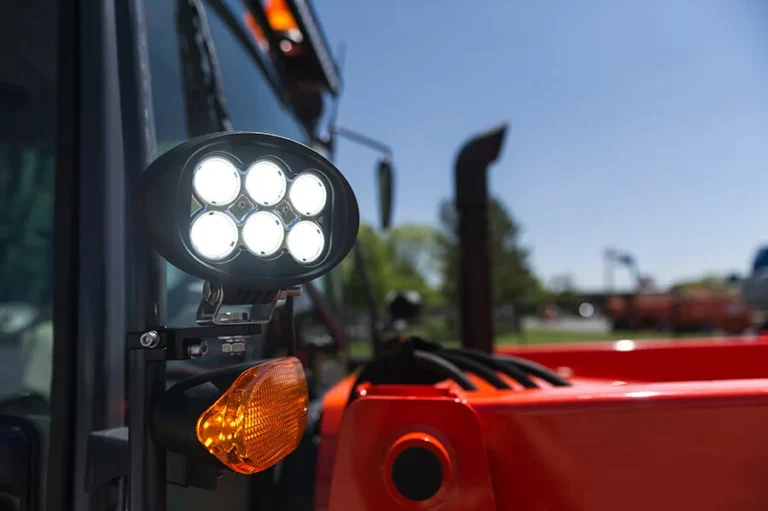
Work lights are legal to fit to a tractor, but RSA guidance is that work or ploughing lamps may be used on private land and must be switched off before using the public road. Article 49(6) of the 1963 Regulations says ploughing lamps shall not be used while the vehicle is on a public road. The RSA also points out that rear white lights are banned on the road because they can look like an approaching vehicle.
Any optional lamp must still follow the colour rules. Article 41 allows only white or yellow light to the front and only red to the rear, with exceptions for indicators, number plate lamps and reversing lamps. Front fog lamps may only be used in dense fog or falling snow, and reversing lamps only while reversing.
What the Gardaí and RSA check
Ordinary tractors with a design speed of 40 km/h or less do not need a periodic roadworthiness test in Ireland, but they must be kept roadworthy at all times. Fast tractors over 40 km/h used for non-exempt work, such as local authority work, construction or quarrying, must pass a CVRT test and display a Certificate of Roadworthiness. Farm use within the State, mainly on the land where the work is done, is exempt.
Lighting is enforced at the roadside by An Garda Síochána, including Roads Policing Units, and by RSA Vehicle Inspectors. A roadside check usually looks at 6 things:
- Side lamps, number plate lighting and headlamps all working and clean.
- Indicators and stop lamps working on both the tractor and the trailer, flashing in phase.
- The amber beacon fitted and switched on.
- Rear reflectors and any reflective markings present and clean.
- No work lights on while driving and no rear fog lamp on in clear weather.
- Projections marked and front loaders lowered.
Using a vehicle or trailer not equipped with the prescribed lamps and identification mark lighting carries a fixed charge of €60. Driving a dangerously defective vehicle is a court offence with 5 penalty points. See lighting offences for agricultural vehicles for the enforcement detail.
Frequently asked questions
Does a tractor need lights to drive on the road in the day?
Yes, for most tractors. Since 1 January 2016 the full lighting system must be fitted and working at all times, not only during lighting-up hours, and the amber beacon must be on whenever the tractor is on a public road. The only exception is tractors manufactured or first registered before 1 January 1980 (30 years or more, in current RSA wording) that are used only in daylight.
Does a 40 km/h tractor need stop lamps?
Yes. In Ireland stop lamps are part of the obligatory lighting system for every tractor and self-propelled machine, whatever the design speed. The UK exemption for slower tractors does not apply here.
Is a beacon a legal requirement on a tractor?
Yes. Every agricultural tractor and self-propelled agricultural machine must have a flashing amber beacon, switched on whenever it is used on a public road. It should be roof-mounted on the centre line where possible, with no part of the lit surface less than 1.27 m from the ground. The only exception is vintage tractors used solely for rallies or display.
Can I use work lights on the road?
No. RSA guidance is that work or ploughing lamps must be switched off before using the public road, and the 1963 Regulations ban ploughing lamps on a public road. White rear-facing work lights in particular can look like an oncoming vehicle and dazzle drivers behind. Switch them off at the field gate.
Who enforces tractor lighting law if tractors don’t have an NCT?
The Gardaí and RSA Vehicle Inspectors enforce it at the roadside. Ordinary tractors do not have a periodic test, so the owner and driver are responsible for checking the lights before each road journey. Fast tractors used for non-agricultural work need a CVRT test.