Lighting Offences for Agricultural Vehicles in Ireland: Fixed Charges and Enforcement
In this guide
A lighting offence is a breach of Irish vehicle lighting law committed when an agricultural vehicle uses a public road. It covers a missing lamp, a broken lamp, a lamp showing the wrong colour, a dazzling or wrongly aimed lamp, a beacon that is missing or switched off, and missing reflective markings. The legal basis is the Road Traffic (Lighting of Vehicles) Regulations 1963, as amended (for farm vehicles, mainly by S.I. No. 249 of 2014), and the Road Traffic Acts. Penalties run from a €60 fixed charge to a court appearance and, for dangerous defects, penalty points.
This guide sets out what a lighting offence is, what it can cost, and who enforces it on tractors, trailers and contractors’ machines. Penalty levels change and the outcome of any case depends on its facts, so treat the figures below as the scale a farmer is dealing with rather than legal advice. The detail covers fixed charges, dangerous defects, penalty points and court, trailers and contractors, the enforcing bodies, and how to avoid a penalty altogether.
What Counts as a Lighting Offence
A lighting offence is any use of a vehicle on a public road that breaks the lamp, beacon or marking rules in the Lighting Regulations. It does not need a crash or a complaint. Using the vehicle on the road in that state is the offence in itself, and a roadside check can establish it in seconds.
The common faults split into five groups. A missing or non-working lamp covers a blown rear lamp, a dead indicator, or a number plate light that does not work. A wrong-colour lamp covers a white light to the rear or a red light to the front. A dazzling or misaimed lamp covers a work light left on while on the road. A missing or obscured reflective marking covers a smashed rear reflector or one buried under muck. And a beacon fault covers a tractor on the road without its flashing amber beacon fitted and switched on.
Timing matters less in Ireland than in the UK. Since 1 January 2016, tractors and self-propelled agricultural machines must have their full lighting system (side lamps, headlamps, rear lamps, stop lamps, indicators, amber beacon and number plate lighting) fitted and working at all times, not just during lighting-up hours. Only older tractors (pre-1980, or 30 years or more according to current RSA guidance) used solely in daylight are exempt, and even they must keep any fitted lights working. A tractor with a dead rear lamp parked in the yard commits no offence, but it commits one the moment it pulls onto the road, day or night. For the full set of rules behind these offences, see Irish agricultural vehicle lighting law.
Fixed Charge Notices and the €60 Charge
Missing lamps are most often dealt with by a fixed charge notice. Under S.I. No. 227 of 2024, the fixed charge is €60 for offences under Article 9 of the 1963 Regulations, including:
- using a vehicle not equipped with the prescribed lamps and number plate lighting;
- using a trailer not equipped with the prescribed lamps and number plate lighting;
- using a vehicle not equipped with a prescribed rear or lateral projecting load lamp;
- using a trailer not equipped with the prescribed marker lamp.
These lighting offences do not appear in the RSA’s chart of offences that carry penalty points (dated 27 October 2022), so they are treated as a fixed charge with no penalty points. The standard amount applies if paid within 28 days, a higher amount if paid in the next 28 days, and after that the matter goes to court.
The fixed charge suits a single, clear fault. A blown bulb, a missing number plate light or a dead trailer board fits this route, because the fault is obvious and the driver can fix it and move on.
Not every lighting fault has a fixed charge. No separate fixed charge was found for failing to dip headlights, dazzle, misuse of fog lamps, beacons or work lamps. Those would be prosecuted as a breach of the Lighting Regulations (under section 11 of the Road Traffic Act 1961) or as another road traffic offence, which means court, with the outcome set by the judge. For the minimum lighting a tractor needs to stay clear of these penalties, see tractor road legal lights.
When a Lighting Fault Becomes a Dangerous Defect
A lighting fault becomes far more serious when the missing or broken lighting makes the vehicle dangerous to use on the road. The RSA penalty points chart lists driving a dangerously defective vehicle as a court offence carrying 5 penalty points, and driving a vehicle before remedying a dangerous defect as a court offence carrying 3 penalty points.
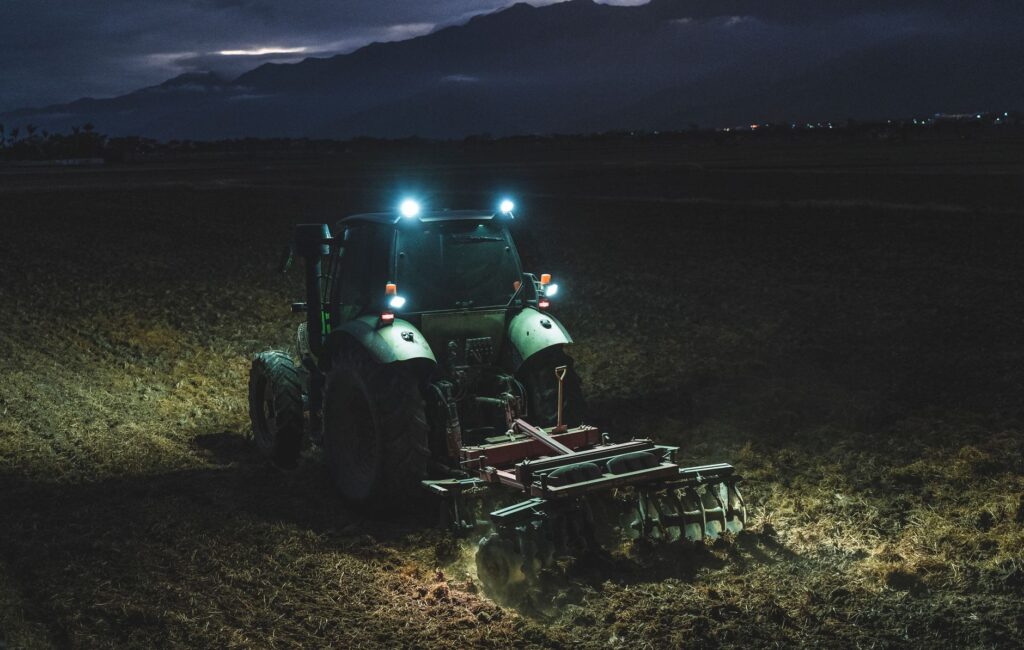
The step up depends on risk, not on the number of faults. A tractor with no rear lights at all, towing an unlit slurry tanker on a dark road at night, is a clear danger to following traffic. In February 2022 the Templemore Roads Policing Unit stopped exactly that, a tractor with no lights at night towing a slurry tanker, and said proceedings would follow. The same Garda might treat one dead marker lamp as a fixed charge matter.
The lesson is that total lighting failure on the road at night is the case to avoid. A vehicle that should never have left the yard in its state attracts the heaviest treatment. Keeping the full lighting system working at all times keeps any fault in fixed charge territory rather than court territory.
Ordinary tractors (design speed 40 km/h or less) do not need a periodic roadworthiness test in Ireland, so a roadside check is often the only inspection their lighting gets. Fast tractors (over 40 km/h) used for non-exempt work such as local authority work, construction or quarrying must pass the CVRT and display a Certificate of Roadworthiness. Using one without a valid certificate can mean a court appearance, a fine of up to €5,000 and/or up to 3 months’ imprisonment, plus 5 penalty points.
Penalty Points and Court
Most lighting offences carry no penalty points, but the most serious can. A fixed charge for missing prescribed lamps adds no points and ends the matter on payment within the time allowed. A dangerously defective vehicle goes to court, with 5 points on conviction.
Court follows when a fixed charge is not paid in time, or when the offence has no fixed charge at all. There is no published fine figure for lighting offences dealt with in court that we can give you, so do not rely on figures from UK guides. The real cost of a court case also includes the time off the farm and any legal costs.
Penalty points in Ireland work on their own scale: 12 points in 3 years leads to disqualification, or 7 for learner and novice drivers. A young driver on a W licence (the tractor category, from age 16) can reach that threshold quickly.
Repeat or commercial offending raises the stakes again. A contractor stopped repeatedly for lighting faults will draw the attention of the Gardaí and RSA Vehicle Inspectors. A single blown bulb is a small matter; a pattern of unlit machines on the road is a business risk. The point of the law is being seen, and the cheapest way to achieve that is a working bulb. For replacement bulbs to keep on hand, see the Agri Lighting bulb and lamp range.
Trailers, Contractors and Responsibility
On a tractor and trailer, the whole outfit is checked. Agricultural trailers and interchangeable towed equipment must have side lamps, rear lamps, stop lamps, indicators and number plate lighting, and the €60 fixed charge covers a trailer without its prescribed lamps just as it covers the tractor. Towed equipment without its own lights (balers, sprayers, rakes and similar) needs a lighting board if it hides the tractor’s lamps or reflectors.
Trailers attract enforcement because trailer lighting fails often. A trailer plug corrodes, a cable chafes through, or a board cracks, and the trailer loses its rear lights while the tractor’s own lights still work. A Garda checks the outfit as a unit, so working tractor lights do not excuse a dark trailer behind them. The driver is expected to check the trailer lights work before pulling onto the road.
Larger trailers have extra requirements. Combinations over 10 m need side marker lamps on the trailer, and agricultural trailers over 3,500 kg design gross vehicle weight need rear reflective markings, side reflective markings over 10 m and a rear “LONG VEHICLE” marking over 13 m (slurry tankers, spreaders and chaser bins are exempt from the marking rules).
Contractors face the rule across multiple machines and operators. A contracting business that runs several tractors and trailers needs every outfit right, because each stop costs time and money and reflects on the business. A quick lights check at the start of each road movement, by each driver, puts that duty in the hands of the people in the seat. For the trailer-specific lighting that must work, see red and white reflectors and the agricultural trailer requirements.
Who Enforces Lighting on the Road
An Garda Síochána enforces vehicle lighting law on Irish roads, including through Roads Policing Units, which run lighting checkpoints. A Garda can stop any vehicle, check its lighting, and issue a fixed charge notice or start proceedings. RSA Vehicle Inspectors carry out roadside roadworthiness checks, often jointly with the Gardaí, mainly on lorries, buses and fast tractors. The RSA and Gardaí report faulty lighting systems as one of the most common major defects found at roadside lorry checks, and faulty brake lights among the most common dangerous defects.
Enforcement rises in the dark months. Silage and slurry runs into the evening, drawing feed and bales in winter, and contractors travelling between farms in poor light all increase the chance of a stop, because that is when lighting faults matter most and show up clearest.
A roadside check is quick and visual. The Garda looks for working lamps front and rear, correct colours, working indicators and stop lamps, the amber beacon on, present and clean reflective markings, and a lit, legible number plate. None of that takes long to inspect, and none of it takes long to check yourself before leaving the yard, which is the whole point of the next section.
How to Avoid a Lighting Penalty
A farm vehicle avoids a lighting penalty when every required lamp works, shows the right colour, the beacon is on, and every reflector and marking is present and clean before the vehicle reaches the road. The checklist below turns the law into a 60-second routine.
- Walk the vehicle before every road movement. Front, rear, both sides. In Ireland the full lighting system must work at all times, not just after dark.
- Check both rear lamps, both indicators and the stop lamps work and show red and amber correctly.
- Check the amber beacon is fitted, working and switched on.
- Check the number plate light lights the plate.
- Check the trailer lights and plug if towing. Working tractor lights do not cover a dark trailer.
- Wipe the reflectors and lenses clear of muck so they do their job.
- Switch work lights off before you go on the public road. The RSA says work and ploughing lamps must be off on the road.
- Carry spare bulbs and fuses so a roadside fault is a two-minute fix, not a tow home.
- Fix faults before the road, not after. A fault spotted in the yard costs a bulb; the same fault on the road can cost a fixed charge or a court date.
Keeping a bulb and fuse kit in the cab, and running the walk-round before every road movement, removes almost every lighting offence a farm vehicle can commit. The cost of getting it right is a handful of bulbs; the cost of a penalty is the charge, the time and, if it escalates, the points.
Summary
A lighting offence is a breach of the Road Traffic (Lighting of Vehicles) Regulations 1963, as amended, committed when an agricultural vehicle uses a public road with missing, broken, wrong-colour or dazzling lighting, a missing or switched-off beacon, or missing reflective markings. Missing prescribed lamps on a vehicle or trailer carry a €60 fixed charge with no penalty points. Other lighting breaches, such as dazzle or work lamps left on, have no set fixed charge and go to court. A vehicle in a dangerously defective state is a court offence with 5 penalty points. On a tractor and trailer the whole outfit is checked, so a dark trailer behind working tractor lights is still an offence. The Gardaí and RSA Vehicle Inspectors enforce the rules, most often in the busy, darker farming months. A farmer who runs a 60-second lights, beacon and reflector check before every road movement, and carries spare bulbs and fuses, keeps clear of the penalties almost entirely. The figures here can change, so treat them as the scale of the risk rather than legal advice.