End Outline Marker Lamps: What They Are and When You Need Them

In this guide
- What an End Outline Marker Lamp Is
- When Irish Rules Require End Outline Markers
- Colour and Position Rules
- Mounting Height and Distance from the Vehicle Edge
- LED vs Filament End Outline Marker Lamps
- Common Fitment Scenarios on Farm Vehicles
- Installing and Wiring End Outline Markers
- Choosing and Buying End Outline Markers
What an End Outline Marker Lamp Is
An end outline marker lamp is a small fixed lamp fitted near the outer edge of a wide vehicle to mark its extreme width to other road users. The lamp shows white to the front and red to the rear. Many corner lamps also include an amber side element, which is a separate side marker function. End outline marker lamps appear on wide agricultural trailers, lorries, slurry tankers, bale carriers, and self-propelled sprayers.
An end outline marker lamp is fitted near the outer edge of a vehicle to indicate its overall width. RSA guidance on lamp colours lists front end outline markers as white and rear end outline markers as red, in line with UNECE Regulation 48. The lamp is small, low-powered, and lit whenever the vehicle’s position lamps (sidelights) are on. It is not a hazard warning light. It does not flash and it does not signal direction.
An end outline marker lamp differs from a side marker light in two ways. A side marker light sits along the middle of the vehicle and marks its length. An end outline marker sits at the extreme corner and marks its width. The two types work together on long, wide vehicles to give a complete outline at night. The side marker lights article covers the side marker function in full.
When Irish Rules Require End Outline Markers
In Ireland, vehicle lighting is governed by the Road Traffic (Lighting of Vehicles) Regulations 1963, as amended, together with EU type-approval rules for new vehicles. Lorries and trailers built to EU type approval generally leave the factory with end outline markers already fitted. The UK width and date thresholds for end outline markers do not apply in Ireland.
For agricultural vehicles, the Irish rules that came in on 1 January 2016 (S.I. No. 249 of 2014) focus on other lamps. Tractors need side lamps, headlamps, rear lamps, stop lamps, indicators, a flashing amber beacon and number plate lighting. Agricultural trailers need side lamps, rear lamps, stop lamps, indicators and number plate lighting, plus a side marker lamp when the tractor and trailer combination is over 10 metres long. The RSA agricultural lighting guidance does not list end outline markers among the obligatory lamps for tractors and agricultural trailers, so check the current RSA guidance for your machine. Fitting them to a wide grain trailer or bale trailer is still good practice, and any lamp that is fitted must work.
A full set is four lamps: two at the front (one near each outer edge) and two at the rear (one near each outer edge). On long combinations, side marker lamps along the body work alongside the end outline markers at the corners.
Using a trailer not equipped with a prescribed marker lamp carries a €60 fixed charge. Lorries and trailers over 3,500 kg take an annual CVRT test, where any fitted lamp that does not work is a failure item. Ordinary tractors (40 km/h or less) and agricultural trailers do not need a periodic test, but they must be kept roadworthy and any marker lamp that is fitted must still work.
Colour and Position Rules
End outline markers must show white to the front and red to the rear. The colour rule matches the Irish rule for all lamps: no light to the front except white or yellow, and no light to the rear except red, apart from indicators, number plate lamps and reversing lamps. Amber to the side belongs to side marker lamps, a separate function that is often built into the same corner lamp.
A typical wide trailer carries four end outline marker lamps in pairs. The front pair shines white through a clear or white lens. The rear pair shines red through a red lens. Many marker lamps combine two colours in a single body using a divider inside the lens, so one lamp on the front corner shows white forwards and amber sideways simultaneously.
The amber side element on a combined corner lamp can act as one of the vehicle’s side marker lamps where it is approved for that function. Long vehicles that need side markers should have them spaced along the body, not just at the corners. The position lamps article explains the sidelight logic that the marker rule builds on.
Mounting Height and Distance from the Vehicle Edge
As a fitting guide, mount end outline markers no more than 400mm in from the side of the vehicle. At the front of a motor vehicle, the top of the lit area should be no lower than the top of the windscreen. At the front of a trailer and at the rear of any vehicle, the lamps go as high as the width rule and the vehicle’s use allow. Check the lamp maker’s fitting instructions for the exact positions.
The 400mm lateral guide means the marker lamp must sit on or near the corner of the vehicle. A grain trailer 2.5 metres wide measured outer edge to outer edge needs its front marker lamps positioned no further than 400mm inward from each outer edge. On a typical trailer this places the lamps directly on the corner uprights.
The point of the height rule is to mark the top corners of the vehicle as well as its width, so other drivers can judge its size. On a tall trailer the rear pair sits near the top of the structure, not down at bumper height.
LED vs Filament End Outline Marker Lamps
LED end outline markers draw 0.1A and last 30,000 hours, while filament markers draw 0.4A and last 1,000 hours. The power and lifespan difference is the main reason farms upgrade their trailer marker fleet from filament to LED.
A typical wide agricultural trailer fitted with eight filament markers (four end outline, four side) draws 3.2A at 12V from the trailer plug. The same trailer fitted with LED markers draws 0.8A. The difference matters when the tractor plug is also feeding flasher lamps, brake lights, and a sidelight circuit on a long umbilical cable.
LED markers also survive vibration better than filament markers. The LED has no fragile tungsten filament to fracture under the constant shake of a loaded trailer on a rough field track. Most LED markers carry an IP67 or IP69K rating, sealing the LED, the resistor, and the connector against silage juice, slurry splash, and pressure-washer cleaning.
Filament markers still have one advantage: they are cheaper to buy. A C5W filament marker costs around €3.50 to €6. An LED equivalent costs around €9 to €17. The total cost over a trailer’s working life favours LED because the LED outlasts 15 to 30 filament replacements.
Common Fitment Scenarios on Farm Vehicles
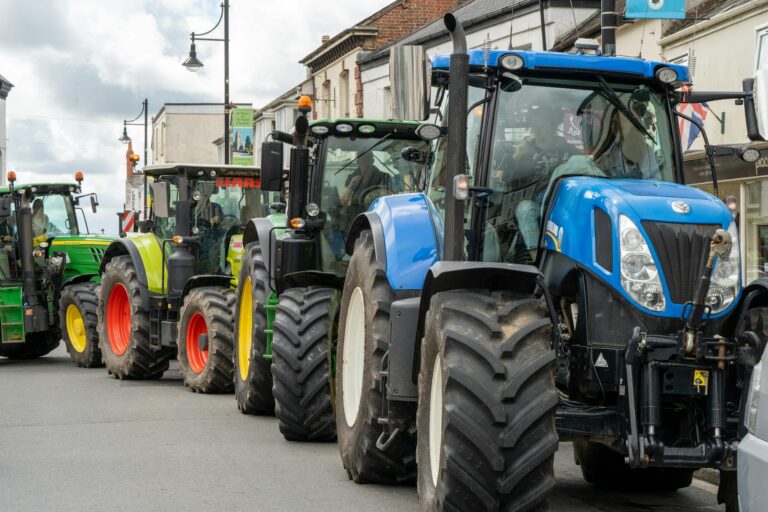
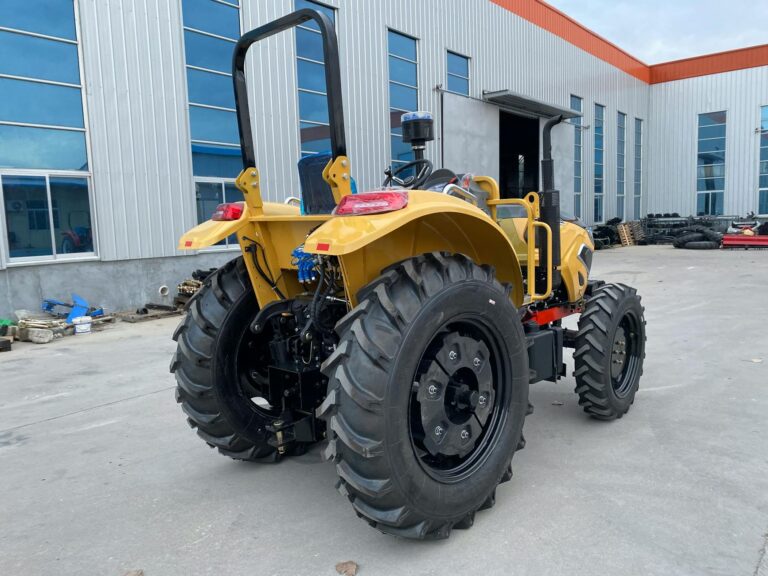
Common fitments include wide agricultural trailers, bale carriers, silage trailers, self-propelled sprayers, slurry tankers, and beet harvesters. Each application uses end outline markers in slightly different positions because the vehicle shape differs.
A flatbed grain trailer carries four corner markers (two front, two rear), and a side marker lamp is needed when the tractor and trailer combination is over 10 metres long. A bale carrier with a flared chassis fits the markers on the outer leg tubes at the front and rear corners. A silage trailer with high sides fits the front markers on the upper headboard so they sit above the cab when the trailer is hitched.
A wide self-propelled sprayer fits front end outline markers on the cab roof corners and rear markers on the boom hinge brackets. A slurry tanker fits markers on the front A-frame and the rear platform rail. A beet harvester fits markers on the lifter frame and the cleaner-loader bed.
The RSA maximum width for an ordinary agricultural tractor is 2.55 metres (2.75 metres for a large tractor over 7.25 tonnes unladen). Adding dual wheels or flotation tyres can take a tractor up to the 3.5 metre limit for those set-ups, so some farms fit removable marker lamps on the dual wheel arms for road movement to show the true width.
Installing and Wiring End Outline Markers
Wire end outline markers to the vehicle’s sidelight circuit using 1mm cable and weatherproof connectors. The markers must come on whenever the sidelights come on and stay on through dipped beam and main beam operation. They do not switch with the ignition alone, and they do not flash with the indicators.
The trailer plug carries the sidelight feeds on dedicated pins. On a 7-pin 12N (ISO 1724) plug, pin 5 (brown wire) feeds the right-hand tail lamps and pin 7 (black wire) feeds the left-hand tail lamps. Marker lamps wire into these two feeds depending on which side of the trailer they sit. On a 13-pin (ISO 11446) plug the same pins are used: pin 5 right-hand and pin 7 left-hand.
Cable runs along the trailer chassis inside a corrugated conduit or a stainless steel braid. Each marker connects to the main run using a Scotchlok or a sealed butt-splice connector. Avoid open spade terminals because moisture seeps in and corrodes the contact within one or two seasons.
The earth return runs back through the trailer chassis or through a dedicated earth wire to the tractor plug. Modern LED markers prefer a dedicated earth wire because chassis earths develop high resistance over time as paint and rust build up between the lamp body and the chassis steel. The agricultural trailer lighting requirements article covers the full trailer wiring layout.
Choosing and Buying End Outline Markers
Choose end outline markers by matching the vehicle width, the mounting position, and the trailer voltage. Most Irish agricultural trailers run on 12V from the tractor plug. A handful of larger continental trailers run on 24V from heavy-duty plant tractors. Many LED markers are rated for both 12V and 24V on the same body; check the marking before fitting.
Lens shape matters. A flat-lens marker sits flush against the chassis or upright. A bullseye lens projects outward and gives wider side visibility but catches branches and gateposts. A combined twin-lens marker shows two colours from a single body and saves wiring on corner positions.
Look for the E-mark on the lamp body. The E-mark shows the lamp is approved to ECE Regulation 7, which covers position lamps, stop lamps and end outline marker lamps. RSA guidance advises fitting like-for-like, type-approved lamps showing the E or e mark, and trailers made on or after 1 January 2016 must use UN/ECE-compliant marker lamps, so buy E-marked lamps for road use. The full Agri Lighting universal marker lamps range lists every approved lamp by voltage, colour, and mounting type.
End outline marker lamps are small, cheap, and easy to overlook. Fitted correctly, they keep a wide trailer visible at the boundary of its footprint. Missed or broken, they expose the operator to a Garda fixed charge, CVRT failures on lorries and heavy trailers, and the genuine risk of a collision where an oncoming driver misjudges the trailer’s width in the dark.