Sealed Beam Headlights for Tractors: Sizes, Irish Rules and LED Options
In this guide
- What a Sealed Beam Headlight Is
- Standard Sealed Beam Sizes
- How to Identify Your Tractor’s Sealed Beam
- Irish Legal Position on Sealed Beams and LED Replacements
- Like-for-Like Sealed Beam Replacement
- LED Conversion in a Sealed Beam Housing
- Wiring and Connector Adaptation
- Tractors Still Running Sealed Beams
- Best LED Replacement Picks
- Related Articles
A sealed beam headlight is a single-piece headlamp where the filament, reflector and lens are sealed inside one glass unit at the factory, and the whole assembly is replaced as a single item when the filament fails. Sealed beams were fitted to many classic tractors, particularly US-built models, and many heritage tractors still run them today. This guide covers the standard sealed beam sizes, the Irish legal position on replacements, and the LED conversion options that fit existing housings.
What a Sealed Beam Headlight Is
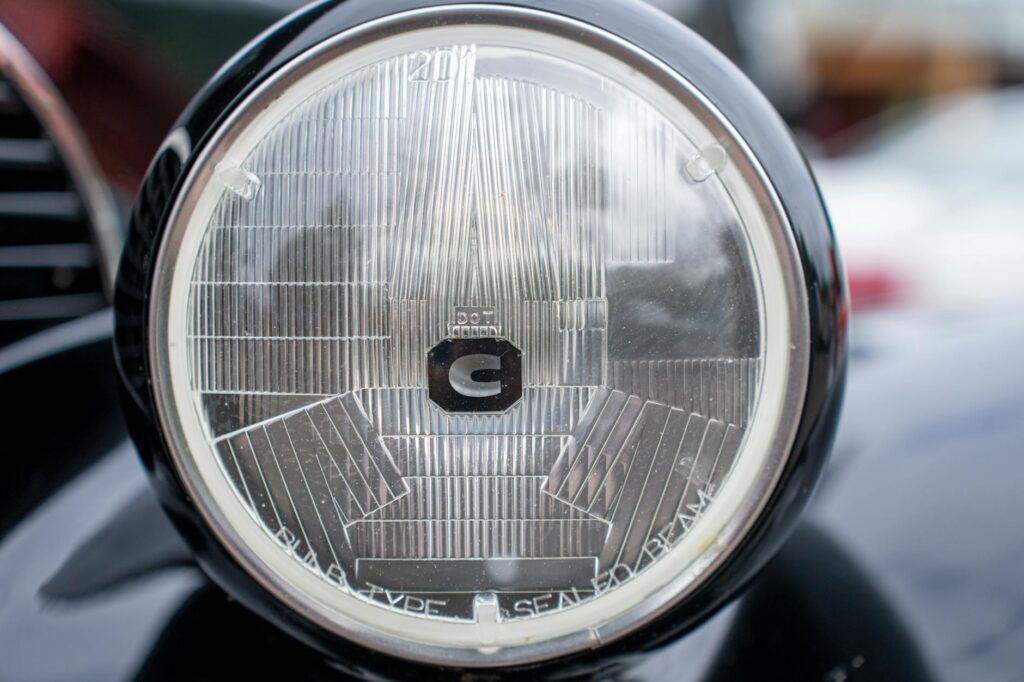
A sealed beam headlight is a one-piece headlamp built as a single glass-and-steel assembly. The filament sits inside the lens. The reflector is the back surface of the glass body. The lens is the front surface, moulded with light-shaping prisms. The assembly is sealed at the factory with no removable bulb and no removable lens.
The sealed beam was invented by GE, Westinghouse and other US lamp makers in 1939, became standard on US cars and trucks from 1940, and dominated North American vehicle headlights until the early 1980s. In Ireland and the UK the sealed beam appeared on imported American tractors, on commercial vehicles, and on some British-built tractors through the 1960s and 1970s before composite headlamps with replaceable H4 bulbs took over.
A sealed beam differs from a modern headlamp in three ways. The first is the failure mode: when the filament breaks, the whole lamp is scrap, because nothing inside it can be opened or repaired. The second is the wiring connection: sealed beams use a three-prong connector built into the back of the glass, not a separate bulb socket. The third is the beam pattern: the lens prisms create the dipped and main beam pattern, with no separate reflector adjustment available.
Standard Sealed Beam Sizes
Sealed beams come in four common sizes, with two round and two rectangular options.
| Size | Shape | Common use | Connector |
|---|---|---|---|
| 7 inch (178 mm) | Round | Single-headlamp tractors, classic cars, motorcycles | 3-prong |
| 5 3/4 inch (146 mm) | Round | Twin-headlamp tractors, US cars, light trucks | 3-prong |
| 4 x 6 inch (100 x 165 mm) | Rectangular | 1970s and 1980s US cars and trucks | 2 or 3-prong |
| 5 x 7 inch (142 x 200 mm) | Rectangular | 1980s US trucks, some tractors | 3-prong |
The 7 inch round is the most common agricultural size, but fitment varies by make, model, year and market, and many tractors use a bulb-type lamp or a rectangular unit instead. Measure the lamp and check the markings before ordering.
The 5 3/4 inch round appears on tractors with quad-headlamp pods or on some larger classic models. The rectangular sizes appear on US-built tractors from the late 1970s onwards and on some 1980s European machines that adopted the US standard.
A sealed beam carries a Type number on the lens that identifies its function. Type 1 is a single-filament main beam unit. Type 2 is a dual-filament unit with both dipped and main beam. A twin-headlamp tractor with four lamps typically runs two Type 2 outer lamps (dipped plus main) and two Type 1 inner lamps (main only).
How to Identify Your Tractor’s Sealed Beam
Identifying the sealed beam on a tractor takes three steps: measure the lens, check the lens markings, and inspect the connector.
Measure the lens across its widest point. A 178 mm measurement confirms a 7 inch round. A 146 mm measurement confirms a 5 3/4 inch round. A rectangle around 100 x 165 mm is a 4 x 6, and around 142 x 200 mm is a 5 x 7.
Check the lens markings. A sealed beam carries moulded markings on the lens face showing the manufacturer (GE, Westinghouse, Sylvania, Lucas, Wagner, Hella), the Type number (1 or 2), the voltage (6V, 12V or 24V) and often a wattage figure.
Inspect the connector on the back of the lamp. A standard sealed beam shows three flat prongs in a triangle pattern at the rear, sized to fit a US-pattern three-blade connector. Two-prong rectangular units use a smaller, in-line connector.
A tractor that runs sealed beams almost always has a circular or square chrome bezel around the lens, with three screws holding the lamp in place against a metal retaining ring. Newer tractors with composite headlamps show a moulded plastic housing with no visible bezel.
Irish Legal Position on Sealed Beams and LED Replacements
Vehicle lighting in Ireland is governed by the Road Traffic (Lighting of Vehicles) Regulations 1963 (S.I. No. 189 of 1963), as amended. Since 1 January 2016, tractors must have a full lighting system, including headlamps, fitted and working at all times, not just during lighting-up hours. Older tractors (pre-1980, or 30+ years old according to current RSA guidance) used only in daylight are exempt from the full system, but any lamps that are fitted must still work. Whatever the age of the tractor, no lamp may be capable of dazzling or misleading other road users (Art. 48 of the 1963 Regulations).
Ordinary tractors with a design speed of 40 km/h or less do not need a periodic roadworthiness test in Ireland, but they must be kept roadworthy on public roads at all times. Classic tractors running sealed beams will almost always fall into this group.
RSA guidance repeatedly advises replacing lamps like-for-like with type-approved units showing the E or e mark. Replacement sealed beam units for European vehicles normally carry an E mark (E1, E2, E11 etc) to ECE R5, the sealed beam regulation. Ireland is in the EU, so EU “e” marks and UNECE “E” marks from any country are recognised. Older US units carry DOT or SAE markings instead. These are original-type parts on many US-built classics, but they are not EU or UNECE approvals, so if you want to follow the RSA advice to the letter, choose an E-marked replacement.
LED units fitted in a sealed beam housing need more care. RSA guidance on LED and HID conversions says retrofit LED light sources are not always compatible with the vehicle or headlamp, and are legal only if type-approved, fitted to a compatible vehicle, and the beam does not dazzle. For cars, an unapproved kit or an approved kit on an incompatible vehicle fails the NCT. See the RSA guidance on HID and LED lights.
Many LED sealed beam replacements on sale carry no ECE approval. An unapproved unit on any road vehicle risks a dazzling beam and goes against the RSA advice, so for road use choose an E-marked unit.
The clearest legal position uses complete LED headlamp units approved to ECE R112 (headlamps with an asymmetric dipped beam) and E-marked. Makers such as JW Speaker sell E-marked versions of their 7 inch LED headlamps. Check the lens for the E-mark before buying, as unmarked versions are also sold.
Like-for-Like Sealed Beam Replacement
Replacing a sealed beam with another sealed beam is the simplest route. The new unit slots into the existing bezel, connects to the existing three-prong wiring and works without any adaptation.
Sources for genuine sealed beam replacements include classic tractor parts dealers, Hella’s classic range, Lucas Classic, and US suppliers. A 7 inch round Type 2 halogen sealed beam (dipped plus main) costs roughly €20 to €55 from these sources. A Type 1 main-beam-only unit costs roughly €15 to €30.
The replacement procedure takes 10 to 15 minutes per lamp:
- Disconnect the battery
- Remove the bezel screws (typically three Phillips or slotted screws)
- Lift the bezel away and free the retaining ring
- Pull the sealed beam forward and unplug the three-prong connector
- Plug the new unit onto the connector
- Fit the new unit into the retaining ring
- Replace the bezel and screws
- Reconnect the battery and test
A like-for-like halogen sealed beam delivers 700 to 1,200 lumens on dipped beam and 1,200 to 1,800 lumens on main beam. The figures match what the tractor produced when new, which suits a vehicle being kept original or used only occasionally.
LED Conversion in a Sealed Beam Housing
An LED conversion in a sealed beam housing replaces the original glass-and-filament unit with a modern LED lamp built to the same overall dimensions and connector pattern. The conversion usually delivers more light at a fraction of the current draw, with no other change to the tractor.
LED sealed beam replacements come in two forms. The first is a one-piece LED lamp shaped like a sealed beam, with the LED chips, the reflector and the lens built into a single unit. The unit slots into the original bezel and plugs into the three-prong connector. The second is a housing-plus-bulb kit, where the housing accepts an H4 LED bulb in a separate socket.
A typical LED 7 inch sealed beam replacement draws 30 to 50 watts. Current draw on 12V runs at 2.5 to 4 amps per lamp, against 5 to 8 amps for a halogen sealed beam of equivalent output. The lifespan reaches 30,000 to 50,000 hours against 500 to 1,000 hours for halogen.
The colour temperature for an LED sealed beam runs at 5,000 to 6,500 Kelvin (daylight white). The original halogen sealed beam ran at 2,800 to 3,200 Kelvin (warm yellow). The cooler LED light improves contrast in night driving but changes the look of a restored classic tractor noticeably.
Wiring and Connector Adaptation
Most LED sealed beam replacements fit the original three-prong connector with no rewiring. The three prongs carry ground, dipped beam and main beam, and the LED unit uses the same pin assignment.
A few LED conversions need adapter pigtails. The most common situation is a tractor wired with the dipped and main beam connections reversed from the US standard. The adapter pigtail swaps the pins to match the LED unit. The pigtail costs roughly €4 to €12 and plugs in line between the tractor loom and the LED lamp.
Older 6V tractors (many built before the late 1950s) need either a 6V LED unit or a 12V conversion of the whole electrical system. A 6V LED sealed beam replacement exists but the choice is narrow. Most 6V tractors keep their sealed beam headlights as part of a period restoration.
24V tractors and commercial vehicles need 24V LED units or multi-voltage units. Several makers offer 9V to 32V LED units that fit both 12V and 24V systems without modification.
Tractors Still Running Sealed Beams
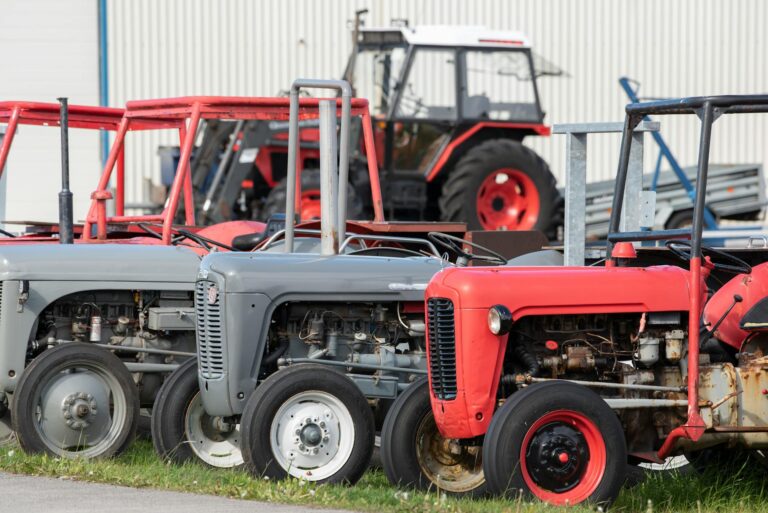
Many classic and heritage tractors still on Irish farms, and at vintage rallies, run sealed beam or bulb-type round headlamps. Original fitment varies by make, model, year and market, and many British-built tractors used bulb-type lamps rather than US-style sealed beams, so measure the lamp and check the lens markings before ordering.
Best LED Replacement Picks
The right LED sealed beam replacement depends on whether the tractor is for daily work or for occasional restoration use.
Daily-work pick for 7 inch round: JW Speaker Model 8700 Evolution 2 in its E-marked version, roughly €250 to €330 per pair. Check the E-mark on the lens, as versions without it are also sold.
Mid-budget pick for 7 inch round: an E-marked 7 inch LED headlamp from a major maker such as Hella, roughly €130 to €190 per pair. A practical balance of output, compliance and cost.
Budget pick for 7 inch round: a generic LED sealed beam replacement with no ECE approval, roughly €35 to €70 per pair. Suits off-road and yard use only. Without an approval mark it does not meet the RSA advice on type-approved lamps, so do not rely on it for the public road.
5 3/4 inch round pick: an E-marked 5 3/4 inch LED unit from a major maker. Choice is narrower than for 7 inch, so check the approval mark, beam type (dipped plus main, or main only) and voltage before ordering.
Rectangular pick: an E-marked LED 4 x 6 or 5 x 7 unit, roughly €95 to €165 each. Direct fit to existing rectangular bezels on 1980s US-built tractors.
Related Articles
- The tractor headlights guide covers all tractor headlamp types and the upgrade options.
- Halogen headlamp bulb types covers H1, H3, H4 and H7 bulbs for tractors with replaceable-bulb headlamps.
- LED headlamp conversions explains the LED upgrade route across all headlamp formats.
- Halogen to LED upgrade walks through the full tractor lighting LED conversion.
- Are LED light bars road legal covers the wider road-legal position on LED upgrades.
- Shop the full range of tractor headlamps including LED sealed beam replacements, with free delivery to Ireland on orders over €150.