Magnetic Beacons: Portable Warning Lights for Tractors and Trailers
In this guide
A magnetic beacon is a portable amber warning lamp held to a steel vehicle surface by a permanent magnet base and powered through a coiled lead plugged into a 12V or 24V socket. It fits a tractor, telehandler, trailer, or van in seconds, comes off without tools, and leaves no holes in the bodywork. The lamp itself is a standard ECE R65 rotating or flashing beacon. The magnet base is the only difference between a magnetic beacon and a fixed-mount unit. That single design choice changes how, where, and when the beacon gets used. This guide covers when a magnetic beacon is the right choice, how to read magnet pull strength figures, which surfaces hold and which do not, what to look for in the power lead, and how to buy a unit that stays legal and reliable on Irish roads.
What a Magnetic Beacon Is
A magnetic beacon is a warning lamp with a permanent magnet built into its base, designed for temporary fitment to a steel vehicle panel. The lamp body, lens, light source, and electronics are identical to those on a fixed-mount beacon. The base is the differentiator: a single large magnet, or a ring of smaller magnets, sits inside a rubber-coated housing. When the beacon is placed on a steel surface, the magnet holds the lamp against the panel through the rubber pad.
A magnetic beacon delivers 3 things a fixed beacon cannot. The unit fits in under 5 seconds without tools. The unit can move between vehicles in the same farm or contractor fleet. The unit leaves no holes in the cab roof, wing, or bonnet. In return, the operator accepts a slightly higher unit price, a coiled cable that needs routing, and a maximum speed, set by the beacon maker, above which the beacon may shift on the magnet.
Most agricultural magnetic beacons measure 100 to 130 mm in diameter at the base, stand 130 to 200 mm tall, and weigh 0.5 to 1.5 kg complete. The base houses 1 large central magnet on smaller units or a 3-magnet array on larger units. The lamp on top is functionally identical to any other ECE R65 beacon. For the wider category, see the tractor beacon lights guide.
When to Choose a Magnetic Beacon Over a Fixed Beacon
A magnetic beacon is the right choice in 4 specific situations. A fixed-mount beacon wins everywhere else.
| Situation | Magnetic | Fixed |
|---|---|---|
| Vehicle used on roads daily | Either | Better |
| Vehicle used on roads occasionally | Better | Either |
| Hire tractor, contractor swap, or shared fleet | Better | Worse |
| Cab too low for permanent beacon (storage barn) | Better | Worse |
| High-speed road work (above 100 km/h for vans/4x4s) | Worse | Better |
| Tractor over 50 kph or wide load | Either | Better |
1. Occasional Road Use
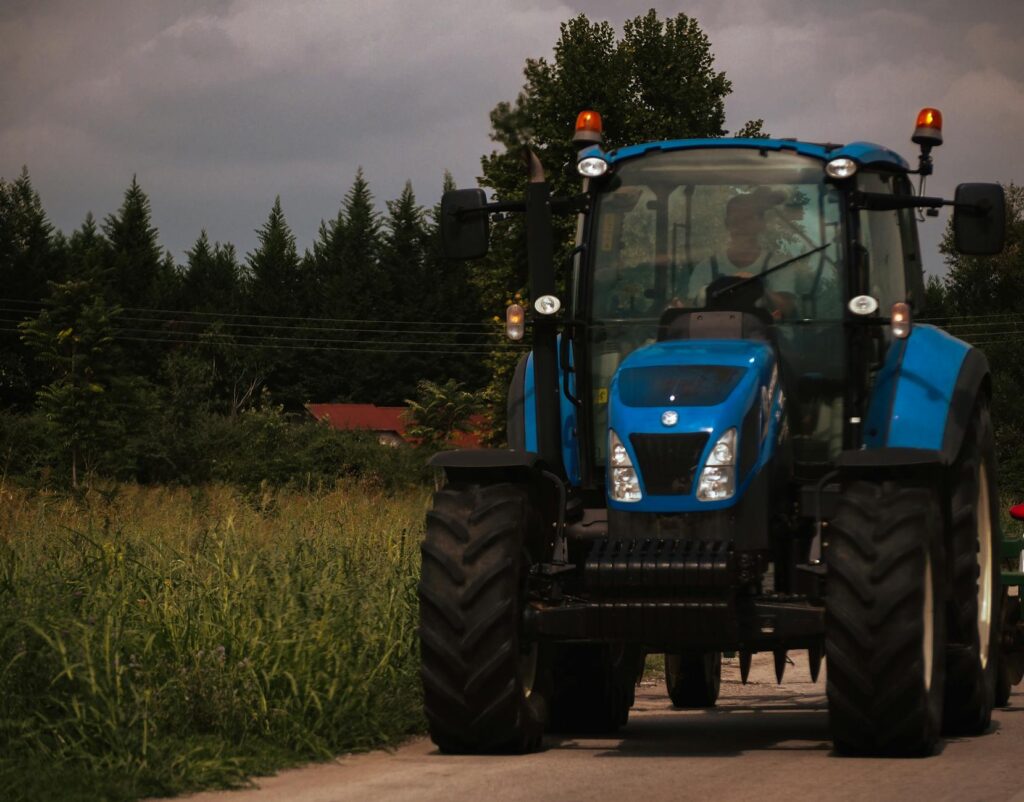
A tractor that spends most of its time in the yard or in fields, and only occasionally moves on a public road, can suit a magnetic beacon. In Ireland every tractor must be fitted with a flashing amber beacon that is switched on whenever it is on a public road, so the magnetic unit has to go on the roof and be switched on before every road trip, even a short run down the local road. If there is any chance it will be forgotten, a fixed beacon is the safer choice.
2. Multi-Vehicle Fleet
A contractor running 3 tractors on a job needs 3 beacons. A magnetic set lets one beacon move between machines as the work shifts. Fixed beacons would need 3 units, 3 sets of wiring, and 3 sets of cab modifications.
3. Storage Constraints
A barn with a low door, a workshop with a low ceiling, or a covered yard often forces the operator to remove the cab beacon for entry. A magnetic beacon comes off in seconds. A fixed beacon requires undoing bolts and disconnecting wiring every time.
4. Hire and Demo Vehicles
A demonstration tractor or hire unit must return to its owner without modifications. A magnetic beacon gives the machine a working amber beacon for the period of use without leaving any trace on the host vehicle. Most modern tractors already have a factory beacon mount, so check that first.
Magnet Types and Pull Strength
A magnetic beacon’s holding power comes from one of 2 magnet types, with pull strength typically rated between 15 and 35 kg. The figure on the product page is the static pull, which is the force needed to lift the beacon straight off a flat steel plate at room temperature.
| Magnet type | Typical pull | Best use | Cost |
|---|---|---|---|
| Ferrite | 8 to 18 kg | Light beacons, slow vehicles, occasional use | Low |
| Neodymium | 20 to 35 kg | Heavier beacons, road use, vibration-prone vehicles | Higher |
| Hybrid (multi-magnet array) | 25 to 50 kg | Heavy lamps, high-speed road use | Highest |
Ferrite Magnets
Ferrite (ceramic) magnets are the original beacon magnet material. They hold reliably at low cost, tolerate heat well (up to 250°C), and resist corrosion. Pull strengths of 8 to 18 kg suit small LED beacons used at slow road speeds. A ferrite-magnet beacon on a tractor cab roof at 40 km/h is stable. The same beacon on a van roof at 120 km/h may shift in cross-winds.
Neodymium Magnets
Neodymium (rare-earth) magnets deliver 2 to 4 times the pull of an equivalent-size ferrite. A 75 mm neodymium magnet pulls 25 to 35 kg compared with 8 to 12 kg for ferrite of the same size. Neodymium suits heavier beacon bodies, faster road use, and any vehicle that bounces over rough surfaces. The trade-offs are higher cost, lower heat tolerance (loses strength above 80°C), and corrosion vulnerability if the rubber coating is breached.
Pull Strength Versus Real-World Use
The static pull rating describes the force on a flat horizontal surface. A real cab roof is curved, painted, and moving, so real-world holding force is lower than the static rating. Check the maker’s stated maximum speed for the beacon, and for faster road use choose a stronger magnet or a magnetic-mount-and-strap combination.
Mounting Surfaces: What Works and What Does Not
A magnetic beacon needs a ferrous surface to grip. Many cab roofs are steel and accept magnetic beacons, but plenty of modern cab roofs are plastic, composite or aluminium, and a magnetic beacon will not stay in place on them.
| Surface | Magnetic? | Notes |
|---|---|---|
| Painted steel | Yes | Standard cab roof on most tractors and vans |
| Bare steel | Yes | Older tractors, trailers, agricultural body panels |
| Galvanised steel | Yes | Trailers, livestock boxes |
| Stainless steel | Variable | Some grades are non-magnetic; test before use |
| Aluminium | No | Some modern lightweight cabs and bodies |
| Fibreglass / GRP | No | Some cab tops, bonnet covers, bodywork |
| Plastic | No | Roof panels, ABS covers, body trims |
Test Before You Trust
A small fridge magnet held to the intended mounting surface confirms the magnetic potential in 1 second. The fridge magnet sticks: a beacon will hold. The fridge magnet falls off: do not fit a magnetic beacon in that position. Aluminium cab tops, fibreglass bonnets, and plastic body panels all fail this test. On those vehicles, the beacon needs a fixed mount, a magnetic-base bracket bolted to a steel sub-section, or a flexi-DIN pole with a fixed base.
Paint Protection
A magnetic beacon’s rubber-coated base protects most painted surfaces from scratching. Three precautions extend that protection. Wipe both the beacon base and the mounting surface clean before each fitment so that no grit gets pinched between the rubber and the paint. Avoid sliding the beacon across the surface; lift it off and place it down. Lift it carefully on freshly painted surfaces, where uncured paint can pull away with the magnet base. Ask the paint shop how long a new respray needs to cure before a magnetic beacon goes back on.
Power Supply Options
A magnetic beacon plugs into the vehicle’s electrical system through one of 3 common lead types. The lead trails from the base of the beacon, runs across the cab roof or through the door seal, and ends in a connector that matches the vehicle’s socket.
Cigarette Lighter Plug
The most common power option for portable beacons. The plug fits any standard 12V cigarette lighter or accessory socket. Lead lengths run 2 to 4 m coiled, expanding to 5 to 7 m straight. The plug type works on tractors, vans, 4x4s, and any vehicle with a 12V auxiliary socket. The single weakness is the lead routing: a coiled cable trailing across a cab roof and into a side window catches in door seals and snags on bodywork.
DIN Socket Plug
Many tractors fit DIN power sockets in the cab specifically for accessories like beacons. A DIN plug locks into the socket against vibration and keeps a clean cab interior. Check the socket and plug current rating against the beacon’s draw. DIN-plug beacons are a common fit on European-spec tractors.
Hardwire
A hardwired magnetic beacon takes power directly from the vehicle’s electrical loom through a fused spur. The beacon has the same magnetic base and the same removable lamp body, but the lead runs into a permanent connection rather than a socket. Hardwire is uncommon for magnetic beacons because it negates much of the convenience benefit; it suits vehicles where the cab socket is already in use or where the beacon needs a higher current draw than a socket can handle.
Multi-Voltage Operation
LED magnetic beacons increasingly carry multi-voltage labelling: 10-30V or 12-24V. The internal driver accepts both 12V and 24V supplies and produces the correct light output on either. Multi-voltage beacons remove the matching error where a 12V unit gets plugged into a 24V supply (and burns out) or a 24V unit plugged into 12V (and runs at half brightness).
LED vs Halogen Magnetic Beacons
LED has replaced halogen as the default light source for magnetic beacons. The numbers explain why.
| Metric | Halogen rotating | LED rotating | LED strobe |
|---|---|---|---|
| Current draw at 12V | 4 to 8A | 0.5 to 1.5A | 0.3 to 1A |
| Bulb life | 500 to 1,000 hours | 30,000 to 50,000 hours | 30,000 to 50,000 hours |
| Vibration resistance | Low (filament) | High | High |
| Flash pattern | Rotating only | Rotating, simulated rotating | Multiple programmable |
| Visibility | Strong, slightly orange | Strong, full amber | Sharper attention pulse |
| Price | Roughly €30 to €70 | Roughly €45 to €140 | Roughly €55 to €165 |
Halogen Magnetic Beacons
Halogen magnetic beacons use a 55W or 70W halogen bulb inside a rotating reflector. The bulb produces strong, warm-tone light. The reflector spins on a small motor to produce the flash pattern. Halogen beacons are still sold for budget applications and replacement use on older tractors, but Irish regulations limit amber warning lamps to 36 watts, so a 55W or 70W halogen beacon is over that limit for road use in Ireland. The current draw of 4 to 8A loads a tractor’s accessory socket near its limit, and the bulb life is the main weakness in agricultural use because vibration shortens it further.
LED Magnetic Beacons
LED magnetic beacons use a ring of LED chips and either a static lens with simulated rotating output or a small motor that spins a smaller reflector. Current draw drops to 0.5 to 1.5A, the bulbs effectively never need replacing, and the lamp body is lighter (which reduces the load on the magnet base). LED is the right choice for any new fitment, and it sits comfortably under the 36 watt limit for amber beacons.
LED Strobe Variants
A strobe magnetic beacon flashes the LED chips directly without a rotating element. Strobes produce a sharper, more attention-grabbing pulse than rotating units, often programmable across 4 to 12 flash patterns. Strobe magnetic beacons are common on highway maintenance, slow-moving escort vehicles, and oversized load lead vehicles.
Road-Legal Status of Magnetic Beacons
A magnetic beacon used on an Irish road must meet the same legal requirements as a fixed-mount beacon. The portable nature does not change the regulation. Three rules apply.
1. ECE R65 Approval
The Irish regulations set the beacon’s colour, wattage and mounting rather than naming R65. R65 is the recognised international standard for warning beacons, though, and an R65 marked beacon is the safe choice. Class 1 beacons have one intensity level. Class 2 beacons have two, a brighter day level and a dimmed night level. For the full regulatory detail, see ECE R65 beacons explained.
2. Correct Use
Since 1 January 2016, every agricultural tractor and self-propelled agricultural machine in Ireland must be fitted with a flashing amber beacon, and it must be switched on whenever the vehicle is in use on a public road (S.I. 249/2014, retained by S.I. 639/2020). The only exception is vintage tractors used solely for vintage rallies or display. A magnetic beacon switched off, or sitting in a cab box, does not meet that rule. Amber beacons are also allowed on a short list of other vehicles, such as breakdown, road works and local authority vehicles; private cars may not use amber strobes.
3. Mounting Position
The Irish rules say the beacon should be mounted on the roof, on the vehicle’s centre line, where possible, with no part of the illuminated surface less than 1.27 m from the ground and the light-emitting area within a 230 mm square. Exhaust stacks or rear-mounted equipment should not block it. A magnetic beacon stuck low on a bonnet does not meet these rules and is hidden from behind by the cab. The standard fix is to mount on the highest point of the cab roof, where the beacon clears all bodywork, or to fit a second beacon.
A magnetic beacon that meets these points is legal and fit for road use. For the broader rules on lighting and approval, see tractor lighting regulations.
Magnetic Beacon Buying Checklist
Use this checklist when specifying a magnetic beacon for any farm vehicle.
- ECE R65 mark visible on the housing (recommended; Class 2 adds a dimmed night mode)
- ECE R10 EMC approval also present
- Magnet pull rated at 20 kg or more for road use
- Neodymium or hybrid magnet for road speeds above 60 km/h
- Rubber base coating intact and free of cracks
- Lead length 3 m or more for cab-roof to cab-socket routing
- Connector matches the vehicle (cigarette, DIN, multi-voltage)
- LED preferred over halogen for current draw and life, and to stay under the 36 W limit for amber beacons
- Voltage matches or unit is multi-voltage rated
- Surface tested with a fridge magnet before fitting on aluminium or composite cabs
Care and Storage
A magnetic beacon lives a harder life than a fixed beacon because it travels between vehicles, gets stored in tool boxes, and gets dropped occasionally. Five care habits extend its working life.
1. Keep the Magnet Face Clean
Grit, swarf, or dried mud trapped between the rubber coating and the mounting surface scratches paint and reduces grip. Wipe the magnet face with a clean cloth before every fitment. A 30-second wipe prevents most paint damage on the host vehicle.
2. Store Base-Down
Stored on its lens, the beacon scratches and the lens optics degrade. Stored on its base, the magnet attracts every loose ferrous item in the toolbox: nails, screws, washers. The compromise is a foam-lined storage box or a wall-mounted hanging hook that lifts the magnet clear of stored ironwork.
3. Avoid High-Heat Storage
Neodymium magnets lose strength at temperatures above 80°C. A beacon stored on a tractor’s exhaust shroud during summer can drop 20% to 30% of its pull permanently. Cab-shelf or toolbox storage avoids the problem.
4. Check the Lead Annually
A coiled power lead flexes 100+ times a year. The connector at each end takes the most stress. Inspect the cigarette plug or DIN connector for cracking, check the cable strain relief at both ends, and replace the lead before the conductor breaks rather than after.
5. Test the Flash Rate
Two minutes with a stopwatch confirms the flash rate. Count flashes over 60 seconds. An ECE R65 beacon is designed to flash at 120 to 240 per minute (2 to 4 Hz). A rate outside that window suggests the motor is failing (rotating beacon) or the driver is failing (LED beacon), and the lamp needs replacement before the next road use.
Browse the full range of magnetic beacons and roof-mounted lighting at Agri Lighting, including LED magnetic beacons in 12V, 24V, and multi-voltage formats and replacement leads. For the broader context, see the pillar guide to tractor beacon lights, the introduction to amber beacon meaning, and the ECE R65 beacons regulatory explainer.