LED Beacons vs Halogen Beacons: Which Is Better for Farm Vehicles
In this guide
- The Role of Warning Beacons on Farm Vehicles
- How Halogen Rotating Beacons Work
- How LED Beacons Work
- Brightness and Visibility Distance Compared
- Lifespan Comparison
- Power Consumption Compared
- Cost Comparison: Purchase and Lifetime
- ECE R65 and ECE R10 Compliance
- Selecting the Right Beacon by Application
- Final Thoughts
LED beacons outperform halogen beacons on lifespan, power draw, and durability, while halogen beacons hold a small advantage on initial purchase price and on the visual presence of a sweeping rotating beam. For Irish farm vehicles that use the public road, an LED beacon is the right choice, not least because the Irish regulations limit amber beacon lamps to 36 watts, which puts a standard 55 W or 70 W halogen beacon over the limit. Halogen still has a place on yard machines, show tractors and other kit that does not go on the road.
This comparison sets out the technical differences between LED and halogen beacons, then translates each difference into what it means on a working farm.
The Role of Warning Beacons on Farm Vehicles
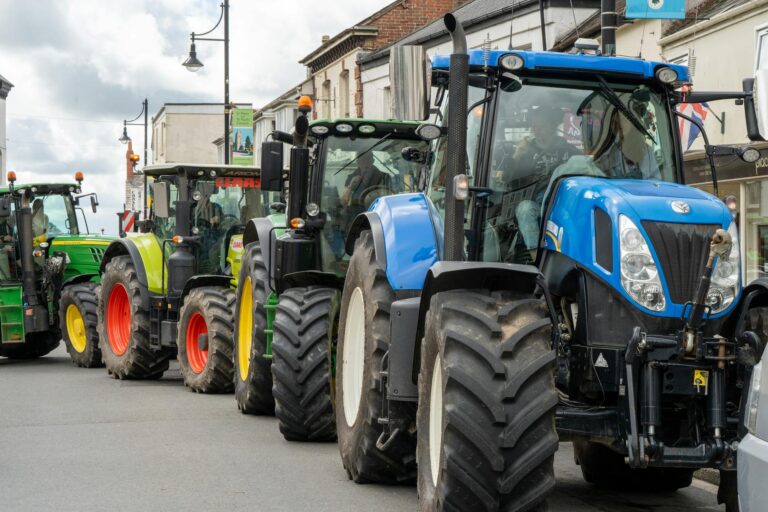
A warning beacon on a farm vehicle is a flashing amber light fitted to alert other road users to a slow-moving or wide vehicle. Irish law requires every agricultural tractor and self-propelled agricultural machine (combines, self-propelled sprayers and foragers included) to be fitted with a flashing amber beacon that is switched on whenever it is on a public road, at any speed and on any road. Beacons are also often added to trailers and slurry tankers where the load hides the tractor beacon.
The beacon does one job: produce a flashing amber warning that is visible at distance, in daylight, and from any angle. Every comparison between LED and halogen technology reduces to how well each does that job over the lifetime of the lamp.
For full detail on when beacons are legally required, see when are amber beacons required on tractors and amber beacon meaning.
How Halogen Rotating Beacons Work
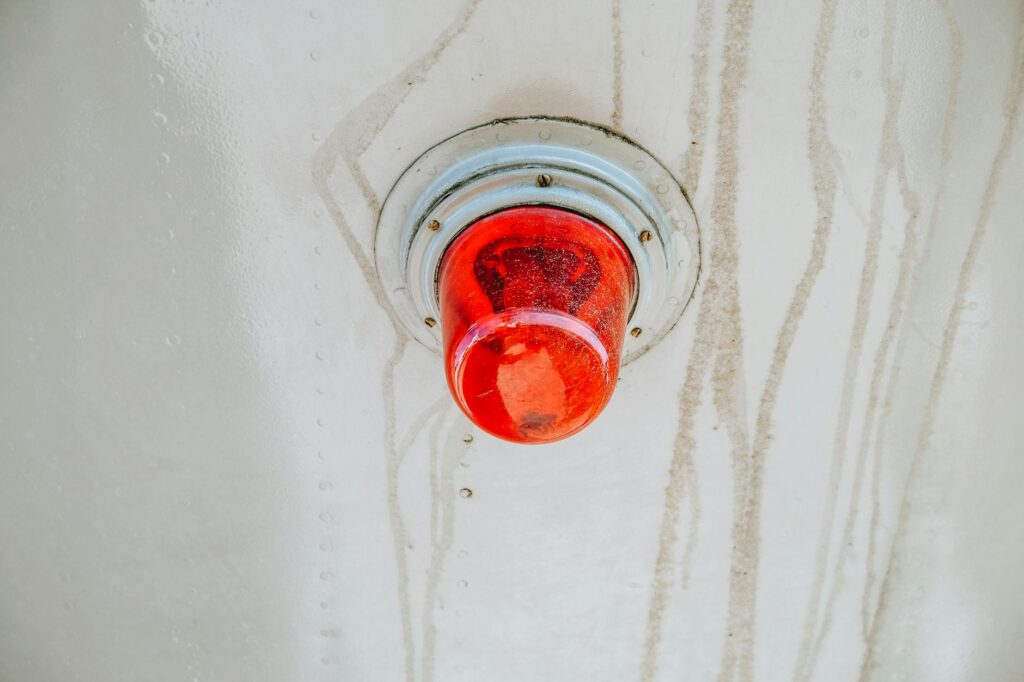
A halogen rotating beacon uses a 55 W or 70 W halogen bulb sat behind a parabolic reflector that a small motor turns around the bulb. The reflector concentrates the bulb’s output into a focused beam, and the rotation produces the classic sweeping flash visible at distance. R65 approval requires 120 to 240 flashes a minute.
The halogen bulb itself is a sealed tungsten filament inside a quartz envelope, filled with halogen gas. The gas regenerates evaporated tungsten back onto the filament, extending bulb life and allowing the filament to run hotter and brighter than a vacuum bulb.
A halogen beacon has three moving parts: the motor, the reflector assembly, and the bulb that periodically needs replacing. The motor and bulb both wear out. The motor lasts 5,000 to 10,000 hours, the bulb 1,000 to 2,000 hours. On a beacon used 800 hours a year, the bulb is changed annually and the motor is replaced after five to ten years.
How LED Beacons Work
An LED beacon uses an array of LED chips driven by a switching driver, with no moving parts. The flash pattern is created electronically. A rotating effect is simulated by sequencing groups of LEDs around a circular layout. A double or quad flash pattern is produced by the driver pulsing the entire array.
The LED chip lifespan exceeds the housing lifespan in almost all cases. A quality LED beacon delivers 30,000 to 50,000 hours before output drops to 70 percent of new (the L70 figure used by manufacturers). On a beacon used 800 hours a year, that is 37 to 62 years.
Because there are no moving parts, an LED beacon survives vibration, shock, and rough handling that destroys a halogen unit. A telehandler crossing rutted yards or a baler running across stubble fields generates vibration loads that snap halogen filaments and wear motor bearings. The same loads have no effect on an LED chip.
LED beacons fall into two physical formats. Static LED beacons use a single LED array under a coloured dome, with the flash pattern produced electronically. Rotating LED beacons mimic the halogen sweep using either a rotating reflector or a sequenced LED array, often combining both for a more visible beam.
Brightness and Visibility Distance Compared
Halogen beacons produce 800 to 1,500 lumens of total light, focused by the reflector into a sweeping beam visible at 500 m to 1 km in good conditions. LED beacons produce 600 to 2,000 lumens depending on grade, with the better units exceeding the brightest halogen at peak.
Brightness alone does not tell the whole story. Three other factors determine visibility on the road:
- Flash intensity peak (candela): the brief peak brightness during a flash
- Effective intensity: the perceived brightness factoring in flash duration
- Beam pattern: how light is distributed horizontally and vertically
ECE R65 is the recognised international standard for warning beacons and sets minimum light output values, although the Irish regulations set colour, wattage and mounting rather than naming R65. Both halogen and LED beacons can meet R65 Class 1 (a single intensity level) or Class 2 (two levels: a brighter day setting and a dimmed night setting).
For agricultural use, R65 Class 1 covers most tractors and trailers. R65 Class 2 suits vehicles that need a brighter daytime signal but also work at night, such as combines and self-propelled sprayers, because the dimmed night level avoids dazzle. Both LED and halogen beacons are available in both classes.
In daylight, top-grade LED beacons appear noticeably brighter than halogen because the cool white peak (filtered amber) cuts through ambient sunlight better than warm tungsten light. In dusk and at night, the difference reduces, and a well-matched halogen still puts on an impressive show. For full information on R65, see ECE R65 beacons explained.
Lifespan Comparison
LED beacons last 15 to 25 times longer than halogen beacons in working hours. The numbers:
- Halogen bulb: 1,000 to 2,000 hours
- Halogen motor: 5,000 to 10,000 hours
- LED chip array: 30,000 to 50,000 hours
- LED driver: 30,000 to 100,000 hours
Halogen filament life is reduced by vibration. A bulb rated 2,000 hours on a stationary fitting often lasts 600 to 800 hours on an active tractor. The reduction does not affect LED beacons, which have no filament.
Cold weather affects neither significantly. Heat affects halogen more (the bulb runs at 250 degrees during use), and high ambient summer temperatures inside a beacon dome shorten halogen bulb life faster than LED life.
Replacement bulbs for halogen beacons cost roughly €5 to €14. A failed motor on a halogen beacon usually means replacing the whole unit. For an LED beacon, a fault is rare, and when it happens the whole unit is replaced because the LED array is sealed and not user-serviceable.
Power Consumption Compared
A halogen beacon draws 55 to 70 W from the tractor electrical system. An LED beacon draws 6 to 25 W for an equivalent visual output. In Ireland that difference is also a legal one, because amber beacon lamps are limited to 36 watts. Beyond the law, the difference matters in three situations:
- Older tractors with limited alternator capacity, where adding a 70 W beacon to existing lighting drains the system at idle
- Battery-operated portable warning lights, where battery life on LED is many times longer
- Vehicles running multiple beacons simultaneously, where the cumulative current draw becomes a real load
For a typical 100 amp tractor alternator, neither halogen nor LED beacon strain the system on its own. The case for LED on power draw becomes stronger as more lighting is added: an LED beacon plus six LED work lights replaces what was once a halogen beacon plus six halogen work lights, and the new system uses a quarter of the current.
For more on power and load planning, see LED vs halogen tractor lights compared and the broader LED vs halogen vs xenon comparison pillar.
Cost Comparison: Purchase and Lifetime
A halogen beacon costs roughly €30 to €70. An LED beacon costs roughly €45 to €175 for an equivalent class. The premium for LED is 50 to 100 percent on initial purchase.
The lifetime picture flips the comparison. Over five years of typical use:
| Cost line | Halogen beacon | LED beacon |
|---|---|---|
| Initial purchase | €40 | €90 |
| Replacement bulbs (5 years, 5 bulbs) | €35 | €0 |
| Motor replacement risk | €40 (50% chance) | €0 |
| Total 5-year cost | €75 to €115 | €90 |
The LED beacon comes out the same or cheaper across five years, before counting the value of avoided downtime, fewer service stops, and consistent visibility through the lifespan.
On cost alone, a beacon used very rarely does not justify the LED premium, because the halogen bulb will not wear out before the housing fails for other reasons. But if that beacon is going on a tractor for a road journey in Ireland, the 36 watt limit means it should be LED anyway.
For magnetic beacon options, see magnetic beacons: portable warning lights for tractors and trailers.
ECE R65 and ECE R10 Compliance
LED and halogen beacons both come in R65-compliant and non-compliant grades. The compliance has nothing to do with the technology: it is a function of how the beacon was designed, tested, and marked.
For Irish road use on tractors and farm vehicles, fit a beacon marked with both:
- ECE R65: confirms the beacon meets the warning light visibility standard
- ECE R10: confirms the beacon does not generate radio interference (relevant on tractors with GPS and auto-steer)
The Irish regulations set the beacon’s colour, mounting (on the roof on the centre line where possible, lit surface at least 1.27 m from the ground, within a 230 mm square) and the 36 watt limit, rather than naming either mark. RSA guidance is to fit type-approved lamps, so R65 is the good-practice choice and R10 matters when the tractor has a GPS receiver. A non-R10 LED beacon can interfere with auto-steer the same way a non-R10 LED work light can, as covered in do LED lights interfere with GPS and auto-steer systems.
Halogen beacons rarely cause GPS interference because they have no high-frequency switching circuit. The motor brushes generate some noise but rarely at GNSS frequencies. The interference issue is overwhelmingly an LED-driver phenomenon.
Selecting the Right Beacon by Application
The best technology for the job depends on three factors: how often the vehicle is used, what guidance system is fitted, and how much vibration the beacon sees.
| Vehicle type | Recommended technology | Reason |
|---|---|---|
| Modern tractor with GPS, daily use | LED, R65 + R10 | Lifespan, low draw, EMC safe |
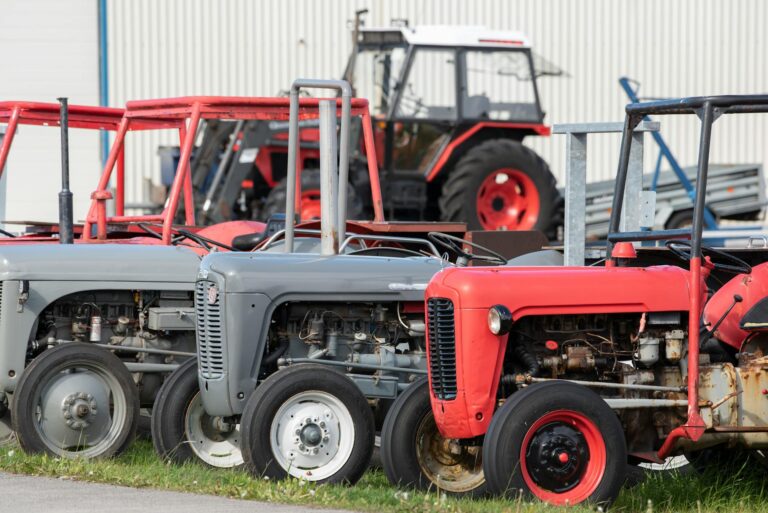
| Vintage tractor used only for rallies or display | Halogen | Exempt from the beacon rule, period look, no GPS to disturb |
| Combine harvester | LED, R65 Class 2 | Long harvest hours, vibration |
| Self-propelled sprayer | LED, R65 Class 2 | Long days, road travel at speed |
| Telehandler | LED | Vibration would destroy halogen |
| Slurry tanker | LED, IP69K | Pressure washing daily |
| Trailer (used seasonally) | LED | Stays under the 36 W limit on the road |
| Magnetic portable beacon | LED | Low draw on a socket, under the 36 W limit |
| Forklift | LED | Indoor use, low draw matters |
For most farms upgrading the fleet today, the answer is LED with R65 and R10 marks. Halogen makes sense mainly on machines that stay off the public road, or on a vintage tractor used only for rallies and display.
When you choose LED beacons or halogen beacons from a specialist supplier, you get the test marks, the right voltage, and the mounting fitment for your machine.
Final Thoughts
The case for LED beacons on farm vehicles is strong, but the choice is not always automatic. Cost, vibration exposure, GNSS sensitivity, and the age of the vehicle all matter.
For any beacon going onto a tractor or trailer used on an Irish road, fit an LED beacon with R65 and R10 marks: it lasts longer, draws less and stays under the 36 watt limit. For a beacon on a yard machine that never leaves the farm, or a vintage tractor used only for rallies, halogen costs less and replacement bulbs are easy to find.
If you need help selecting the right beacon for a specific machine, contact our team at Agri Lighting on +44 1522 440522 or [email protected]. We supply both technologies, every common mount type, and the documentation to confirm road-legal compliance.