Driving Lamps and Spot Lamps: Long-Range Illumination Explained
In this guide
- What a Driving Lamp Is and What It Does
- Driving Lamp, Spot Lamp, and Fog Lamp: The Difference
- Spot Lamps: The Pencil Beam for Maximum Distance
- Beam Patterns and Candela: How Long-Range Output Is Measured
- Driving and Spot Lamps on Tractors, 4x4s, and Farm Vehicles
- Irish Rules: When You Can Use Driving Lamps
- Choosing and Fitting Driving and Spot Lamps
A driving lamp is an auxiliary forward-facing lamp that extends the range of a vehicle’s main beam on unlit roads and tracks. The driving lamp throws a long, narrow beam to 500 metres or more, well beyond the 200-metre reach of a standard main beam. A spot lamp is a driving lamp with the tightest beam of all, a pencil of light 5 to 10 degrees wide that reaches the greatest distance. Both lamp types supplement the headlamp rather than replace it, both wire to the main beam circuit, and both come with road rules in Ireland that an operator must follow. This guide covers the function, beam patterns, candela measurement, agricultural use, and law for driving and spot lamps.
What a Driving Lamp Is and What It Does
A driving lamp is a high-intensity auxiliary lamp that adds long-range illumination to a vehicle’s main beam. The driving lamp sits at the front of the vehicle, alongside or above the headlamps, and points straight ahead. The lamp produces a concentrated beam that reaches further down the road than the headlamp alone.
The driving lamp solves a single problem: the standard main beam runs out of useful light at 150 to 200 metres. On a dark rural road at 80 km/h, a vehicle covers 22 metres per second, so 200 metres of light gives the driver 9 seconds of reaction distance. A driving lamp extends that beam to 500 to 800 metres, which buys the driver more time to react to a hazard.
The driving lamp works only as a supplement. The lamp wires to the main beam circuit, so it switches on with the headlamp main beam and switches off when the driver dips for oncoming traffic. The driving lamp never operates on its own as the vehicle’s primary light, and it never operates with the dipped beam.
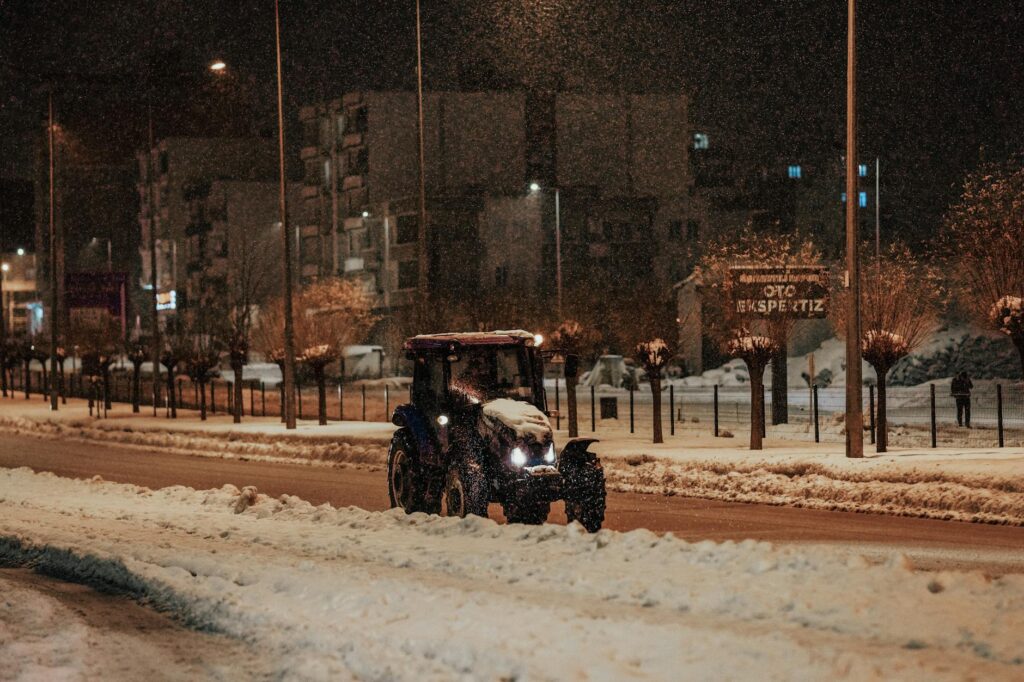
Three vehicle types fit driving lamps most often: agricultural tractors working long night shifts, 4x4s and pickups used on unlit farm tracks, and rally or expedition vehicles. Each uses the lamp for the same reason, which is more light further down an unlit route.
For the wider auxiliary lighting picture, see Fog Lamps, DRLs, and Auxiliary Lights: What They Do and When You Need Them and Fog Lamps Explained: Front and Rear, LED and Halogen.
Driving Lamp, Spot Lamp, and Fog Lamp: The Difference
A driving lamp, a spot lamp, and a fog lamp perform three different jobs and produce three different beams. The confusion between them is common because retailers often group all three under one “spot, fog and driving” category. The beams are not interchangeable.
| Lamp type | Beam shape | Reach | Job | When used |
|---|---|---|---|---|
| Driving lamp | Long, moderately wide | 500 to 800 m | Extend main beam on open roads | Main beam on, no oncoming traffic |
| Spot lamp | Narrow pencil | 700 to 1,000 m | Maximum-distance illumination | Main beam on, long straight tracks |
| Fog lamp | Wide, low, sharp cut-off | 30 to 60 m in fog | Cut under fog and rain | Dense fog or falling snow only |
The driving lamp and the spot lamp both point far ahead and both supplement the main beam. The difference between them is beam width. A driving lamp spreads light across a wider arc (around 20 to 40 degrees), so it lights the verges as well as the road centre. A spot lamp concentrates the same power into a 5 to 10 degree pencil, so it reaches further but lights a narrower strip.
The fog lamp does the opposite of both. The fog lamp throws a wide, low beam with a sharp horizontal cut-off, designed to light the road surface beneath a fog layer without bouncing glare back at the driver. A driving lamp or spot lamp used in fog makes visibility worse, because the long beam reflects off water droplets.
A practical setup pairs the two long-range types: one spot lamp for distance and one driving lamp for spread, mounted side by side. The combination lights the road centre to 800 metres and the verges to 300 metres.
For the fog lamp detail, see Fog Lamps Explained. For the beam optics behind work lighting, see Flood vs Spot Beam: Which Beam Pattern for Which Tractor Task.
Spot Lamps: The Pencil Beam for Maximum Distance
A spot lamp is a driving lamp built for distance, producing a narrow pencil beam of 5 to 10 degrees that reaches 700 to 1,000 metres. The spot lamp concentrates all its output into a tight cone. The narrow cone trades width for reach, so the lamp lights a small circle a long way off rather than a wide area close in.
The spot lamp suits three situations. Situation one, long straight farm tracks where the operator needs to see the far end before committing the vehicle. Situation two, open hill ground where livestock or obstacles sit at distance. Situation three, expedition and rally driving where speed on unlit routes demands the maximum forward sight line.
A spot lamp on its own lights a narrow strip and leaves the verges dark. The standard fix pairs a spot lamp with a driving lamp or a flood beam. The spot covers the centre distance, and the wider lamp fills the foreground and the sides.
Spot lamps come in round and rectangular bodies from 100 mm to 225 mm across. A larger reflector or lens concentrates more light into the pencil beam, so a 225 mm spot lamp reaches further than a 100 mm unit of the same wattage. LED spot lamps now match or exceed the reach of the old halogen and HID units at half the power draw.
For the beam pattern comparison across work and driving lighting, see Work Light Beam Patterns: Flood, Spot, and Combo Explained.
Beam Patterns and Candela: How Long-Range Output Is Measured
Long-range lamp performance is measured in candela, the unit of beam intensity, not in lumens. Candela states how bright the beam is at its brightest point. Lumens state the total light the lamp produces in all directions. A spot lamp and a flood lamp can share the same lumen figure, but the spot lamp records far higher candela because it focuses that light into a tight cone.
Three figures describe a driving or spot lamp on a spec sheet.
Peak beam intensity in candela. A mid-range LED driving lamp records 100,000 to 250,000 candela. A high-end spot lamp records 300,000 to 500,000 candela. The candela figure drives the reach.
Effective range in metres. Manufacturers commonly quote range to the point where the beam falls to 0.25 lux (roughly the light of a full moon, enough to pick out an obstacle). A 200,000 candela lamp reaches about 890 metres to 0.25 lux. A 500,000 candela lamp reaches about 1,400 metres.
Beam angle in degrees. A spot beam runs 5 to 10 degrees. A driving beam runs 20 to 40 degrees. A flood beam runs 60 degrees or more. The angle sets the trade between reach and spread.
The buyer should read the candela and the beam angle together, not the lumens alone. A 10,000-lumen lamp with a 60-degree flood beam lights a wide yard but reaches no distance. The same 10,000 lumens in a 6-degree spot beam reaches over a kilometre.
For the relationship between lumens, lux, and beam output, see Understanding Lumens, Lux, and Colour Temperature in Agricultural Lighting.
Driving and Spot Lamps on Tractors, 4x4s, and Farm Vehicles
Driving and spot lamps extend the working night for agricultural and off-road vehicles where headlamps alone fall short. Farm vehicles travel unlit tracks, headlands, and rural roads after dark for much of the working year, and the standard tractor or pickup headlamp reaches only 150 to 200 metres. A long-range lamp lifts that to 500 metres or more.
Four farm applications justify a driving or spot lamp.
Road haulage at night. A tractor pulling a trailer at road speed (up to 40 km/h for most tractors, faster for fast tractors built for over 40 km/h) on rural roads benefits from a driving lamp that lights the road far enough ahead to spot a bend or a parked vehicle at speed.
Track and headland travel. A spot lamp on a pickup or quad lights the far end of a long track before the vehicle commits to it, which matters on single-track farm roads with no passing places.
Livestock checks on open ground. A spot lamp picks out animals at 300 to 700 metres across a dark field, which speeds a night check without leaving the vehicle.
Expedition and 4×4 work. A combination of spot and driving lamps lights both the distance and the verges on rough ground where the route is unmarked.
The mounting position for a driving lamp on a tractor is the roof line, the cab front rail, or a bull bar on a pickup. The lamp wires to the main beam circuit through a relay, with a dashboard tell-tale that shows when the lamp is live. A typical fit takes 90 to 120 minutes for one pair.
For the road-legal limits on extra forward lighting, see Can You Use LED Light Bars on Public Roads. For roof-mounted setups, see Roof-Mounted Warning Systems: RTK, OWS, and Lightbar Options.
Irish Rules: When You Can Use Driving Lamps
In Ireland, vehicle lighting is governed by the Road Traffic (Lighting of Vehicles) Regulations 1963, as amended. The Rules of the Road says fitting optional lighting is controlled by law, so take care before fitting spot lights or other add-ons, get professional advice and tell your insurer. Three rules cover sensible, legal use.
Rule one, wire driving lamps so they go off when the main beam is dipped. A driving lamp is a main-beam supplement, so it should not be able to stay lit with the dipped beam. Driving with a long-range lamp lit toward oncoming traffic dazzles other drivers.
Rule two, driving lamps may not be used in a way that dazzles another road user. Article 48 of the 1963 Regulations says lamps must not be capable of dazzling, and no lamp capable of misleading other traffic may be fitted. A lamp aimed too high, or left on when a vehicle approaches, breaks that rule and can be prosecuted as a breach of the lighting regulations.
Rule three, only permitted colours and working lamps. Only white or yellow light may show to the front, and every lamp that is fitted must work. On cars, vans and 4x4s, a fitted lamp that does not work is a failure item at the NCT or CVRT. Ordinary tractors (40 km/h or less) do not need a periodic test, but they must be kept roadworthy and the same lighting rules apply on the road.
The rules on dazzle apply to every vehicle on the road at any speed, tractors included. The safe rule for any operator is simple: wire long-range lamps to the main beam, aim them correctly, and switch them off for oncoming traffic.
For the full road-legal picture, see Can You Use LED Light Bars on Public Roads and Tractor Road Legal Lights: The Minimum Lighting Kit.
Choosing and Fitting Driving and Spot Lamps
The driving or spot lamp purchase rests on 6 specifications: beam type, candela, technology, size, voltage, and approval. The 6-point check matches the lamp to the job and keeps it road-legal.
Specification one, beam type. Spot for maximum distance, driving for distance plus spread, or a matched pair for both. The spec sheet states the beam angle in degrees.
Specification two, candela and range. Higher candela means longer reach. A 200,000 candela lamp suits most farm road work. A 400,000 candela spot lamp suits open ground and high-speed tracks.
Specification three, technology. LED for new fitment, with lower power draw and a 30,000 to 50,000 hour life. HID and halogen remain on older vehicles but draw more power and last fewer hours.
Specification four, size. 100 mm to 140 mm lamps suit compact mounting. 180 mm to 225 mm lamps reach the greatest distance and suit roof and bar mounting.
Specification five, voltage. 12 V for most tractors and pickups, 24 V for larger machines, or a multi-voltage 9 to 33 V LED unit for a mixed fleet.
Specification six, approval. An E-mark on the lens confirms the lamp is built to a recognised standard for road use. RSA guidance is to fit type-approved lamps showing the E or e mark. A lamp with no approval mark is for off-road use only.
The fitting process wires the lamp through a relay to the main beam feed, so the lamp draws its current from the battery rather than the headlamp switch. The fitter mounts the lamp, runs the relay and fused supply, connects the switch and tell-tale, and aims the beam against a wall at 10 metres. A competent fitter completes one pair in 90 to 120 minutes.
For the buying and fitting picture, see Best LED Work Lights for Tractors and How to Choose Agricultural Lighting. For products, browse the auxiliary lamps and work lamp categories at Agri Lighting.
The summary picture for driving and spot lamps on Irish vehicles in 2026: driving lamps add spread and distance, spot lamps add maximum reach, both supplement the main beam and must switch off when it dips, candela rather than lumens sets the reach, and an E-mark is the buyer’s checkpoint for any lamp going on a road vehicle.