Slim Lightbars vs Traditional Beacons in Ireland: Which Gives Better Visibility
In this guide
A slim warning lightbar is a low-profile, multi-LED amber warning light, typically 300 to 1,200mm long and 30 to 90mm tall, that replaces a single traditional beacon with a wider, brighter light pattern. A traditional beacon is a single dome-shaped rotating or flashing warning light, typically 150 to 220mm in diameter and 100 to 250mm tall, fitted to a DIN pole or bolt-on base. In Ireland the choice matters more than in the UK, because since 1 January 2016 every tractor and self-propelled agricultural machine must have a flashing amber beacon fitted and switched on whenever it is on a public road. This guide compares the two on visibility, how they fit the Irish beacon rules, ECE R65 approval, power draw, mounting, cost, and use cases, so the right choice is clear before purchase.
What a Slim Warning Lightbar Is
A slim warning lightbar is a horizontal LED light unit that produces amber warning flashes across a wide angle, fitted to the cab roof, the front of a telehandler, or the rear of a sprayer. The unit contains 8 to 32 LED modules behind a clear or amber polycarbonate lens, with each module timed to flash in patterns selected by the operator (single flash, double flash, simulated rotation, alternating left-right). The total length runs from 300mm for compact units to 1,200mm for full-cab-width bars on larger machines.
The slim lightbar form factor delivers four practical advantages over a single beacon.
- Lower profile, with the top of the bar sitting 30 to 90mm above the mount surface. The bar clears low shed doors, gateways, and overhead pipework that a 250mm rotating beacon would strike.
- Wider visibility footprint, with 1,200mm of horizontal light source visible to oncoming road users from 500 to 800 metres. A single beacon is a 200mm point source from the same distance.
- Programmable flash patterns, with a built-in controller offering 6 to 12 different patterns selectable by a dashboard switch. Traditional beacons produce one fixed pattern.
- Integrated stop, tail, and direction-indicator functions on some agricultural-spec models, combining warning beacon and rear lighting into one unit on telehandlers and trailers.
For the wider beacon and warning light context, see the cluster pillar Beacons and Warning Lights for Agricultural Vehicles and the related guide on Beacon Light Bars for Agricultural Vehicles.
What a Traditional Beacon Is
A traditional beacon is a single warning light fitted to a DIN pole, magnetic base, or bolt-on bracket, producing 360 degree amber visibility through a domed lens. The internal light source is either a halogen bulb spinning behind a rotating reflector (the classic rotating beacon), a static halogen bulb behind a clear dome (static), or a ring of LEDs with electronic flash sequencing (LED beacon). Diameter is 150 to 220mm at the dome, height is 100 to 250mm, and the form factor has been the agricultural standard since the 1970s.
The traditional beacon delivers three strengths the lightbar does not match.
- True 360 degree visibility. The single dome shines equally in every horizontal direction, so road users approaching from any angle see the warning at the same intensity. Slim lightbars are strongest from the front and rear and weaker from the sides.
- Universal fitment. Nearly every tractor, telehandler, sprayer, and trailer has either a DIN socket or a magnetic-compatible surface ready to take a single beacon. Lightbars need a permanent bolted mount on a flat surface large enough for the bar length.
- Lower up-front cost. A quality LED traditional beacon costs roughly €30 to €95; a comparable slim lightbar costs roughly €70 to €400.
The traditional beacon has been the default agricultural choice for 40+ years and is the warning light Irish road users expect to see on a tractor. It also fits the Irish mounting rules neatly (see below). The shift to lightbars is recent and partial; most farm tractors still run a single rotating or LED beacon as the primary warning light. For the technology choice within traditional beacons, see LED Beacons vs Halogen Beacons: Which Is Better for Farm Vehicles.
Visibility Comparison
Slim lightbars produce a wider visible target from front and rear; traditional beacons produce equal visibility from every angle. The two designs solve the visibility problem differently, and the right choice depends on which direction of approach matters most for the vehicle in question.
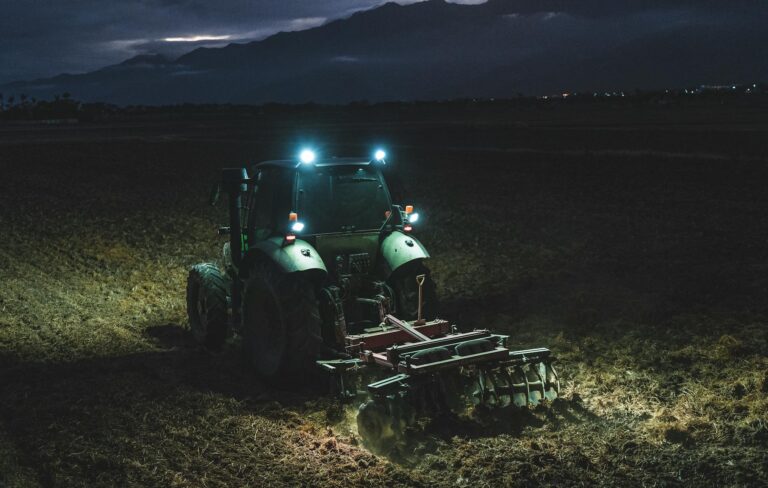
A slim lightbar fitted across the rear of a sprayer, telehandler, or combine produces a 1,000 to 1,200mm-wide bright bar visible to following traffic from 500 to 800 metres on a clear night. The same vehicle with a single rear beacon shows a 200mm bright point at the same distance. For overtaking traffic on a regional road, the lightbar reads as “wide slow-moving vehicle” instantly; the beacon reads as “warning point, vehicle width unknown.”
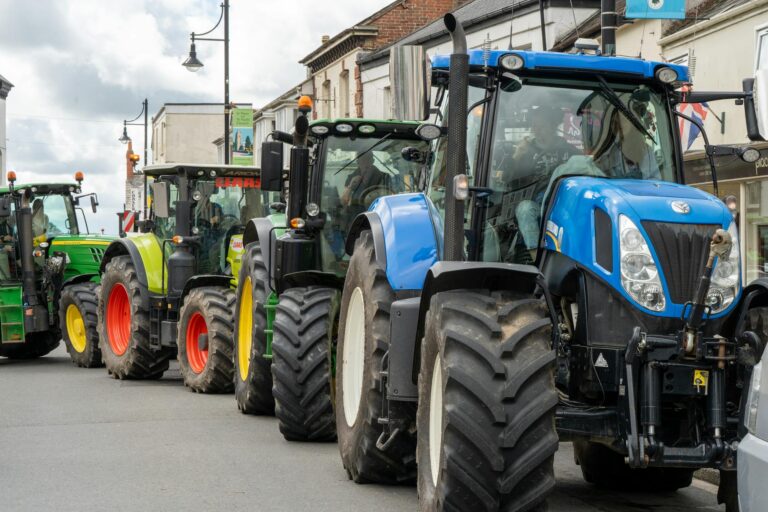
A traditional beacon mounted on the cab roof produces equal visibility in every horizontal direction, including the sides where the lightbar is weakest. The 360 degree pattern matters for tractors crossing junctions, pulling out of field gates onto narrow local roads, or working in farmyards where people and vehicles approach from any angle. The lightbar at the same position has strong front-and-rear visibility but weaker side visibility; check the maker’s light distribution data.
A combined setup uses both. Large agricultural rigs (combines, self-propelled sprayers, baling rigs) often run a slim lightbar across the rear for following-traffic warning AND one or two traditional beacons on the cab roof for 360 degree visibility. The two systems cost roughly €230 to €580 combined, which is justified on machines worth €100,000+ and operating on public roads daily.
Flash Intensity and Eye Attraction
Flash intensity, measured in candela, governs how quickly a warning light draws driver attention from peripheral vision. ECE R65 sets minimum effective intensities over a defined angular pattern, and quality slim lightbars and traditional LED beacons approved to R65 meet them.
The slim lightbar produces its peak intensity in a narrow vertical fan (typically 8 to 15 degrees), which suits road use where the observer is roughly at the same height as the bar. Traditional beacons produce their peak intensity in a wider vertical fan (15 to 25 degrees), which works for observers at varying heights, including pedestrians, car drivers, and lorry drivers all approaching the same agricultural machine.
The flash pattern affects attention capture independently of intensity. Single-flash patterns tend to attract attention faster than rotating patterns, because the LED single flash has a sharper on-off edge than the rotating reflector’s smooth sweep. Slim lightbars almost always use single or double LED flash patterns; traditional rotating beacons remain on the smoother rotation pattern. LED traditional beacons can match the lightbar pattern selection.
Irish Beacon Rules and ECE R65
Irish beacon law is set by the Road Traffic (Lighting of Vehicles) Regulations 1963, Article 52(18), as inserted by S.I. No. 249 of 2014 and replaced by S.I. No. 639 of 2020. The key points:
- Mandatory fitting and use. Every agricultural tractor and self-propelled agricultural machine must be fitted with a flashing amber beacon, switched on whenever it is in use on a public road, on any road type and at any speed. The only exception is vintage tractors used solely for rallies or display.
- Mounting. Where possible on the roof, on the vehicle’s centre line, with no part of the illuminated surface less than 1.27 m from the ground.
- Size and power. The light-emitting area must fall within a 230 mm square, and amber lamps are limited to 36 watts.
- Who may use amber. Amber warning lamps are restricted to listed vehicles, which include agricultural tractors and self-propelled machines, road works and road clearance vehicles and breakdown vehicles. Private cars may not use amber strobes.
The size and power points matter for lightbars. A traditional beacon sits comfortably inside a 230 mm square and well under 36 W in LED form. A long slim lightbar does not fit inside a 230 mm square, and a 900 to 1,200mm bar can draw more than 36 W. We have not found RSA guidance on how lightbars are treated under these rules, so do not rely on a long lightbar alone as your tractor’s required beacon. Fit a compliant roof beacon on the centre line, and treat a lightbar as additional warning, or check with the RSA and the lamp maker first.
ECE R65 is the UN regulation that defines performance and approval requirements for special warning lamps (amber, blue and red), including amber beacons and lightbars. R65 approval, shown as an E or e mark with a country number and a code such as TA1 or TA2, is the recognised mark of a properly tested unit. Ireland recognises both EU (e) and UNECE (E) approval marks. For full coverage of the regulation, see ECE R65 Beacons: What the Regulation Means and Why It Matters.
Three key R65 requirements that apply to both designs.
- Photometric performance. Effective candela must meet defined levels across a horizontal angle of 360 degrees for a single beacon or across the unit’s advertised arc for a lightbar.
- Flash frequency. R65 allows 2 to 4 Hz (120 to 240 flashes per minute).
- Durability and environmental testing. Vibration, temperature, ingress protection, and impact resistance all tested under defined cycles.
Some imported lightbars carry only a CE mark; CE says nothing about warning lamp performance. Check the body marking and the supplier’s compliance documentation before purchase. For the official summary of Irish agricultural lighting rules, see the RSA guide to lighting and visibility laws for agricultural vehicles.
Power Draw and Electrical Impact
LED slim lightbars and LED traditional beacons both draw 1 to 4A on 12V supply, which is low enough that neither type strains a tractor electrical system or alternator. Because an Irish tractor runs its beacon every time it is on the road, an LED unit is the sensible choice either way.
Typical power draw figures by type.
| Light Type | Power Draw (12V) | Annual Cost Estimate (1,000 hours use) |
|---|---|---|
| Halogen rotating beacon | 2.5 to 5A (30 to 60W) | €7 to €14 |
| LED traditional beacon | 0.5 to 1.5A (6 to 18W) | €1 to €5 |
| LED slim lightbar, 300 to 600mm | 1 to 2.5A (12 to 30W) | €2 to €8 |
| LED slim lightbar, 900 to 1,200mm | 2 to 4A (24 to 48W) | €6 to €12 |
Note that a halogen beacon over 36 W, and the larger lightbars, exceed the 36 W limit for amber lamps in the Irish regulations. The halogen rotating beacon is the only type that meaningfully impacts the electrical system, and the swap to LED (in either form factor) reduces electrical draw by 70 to 80%. The shift also extends bulb-replacement intervals from 6 to 12 months for halogen to 5 to 10 years for LED.
For the wider power comparison across all vehicle lighting, see Power Draw Comparison: LED, Halogen, and Xenon on 12V and 24V Systems.
Mounting and Form Factor
Mounting differs significantly between the two designs. Traditional beacons fit DIN sockets, magnetic bases, or single-point bolt-on brackets, all standardised and small. Slim lightbars require a flat horizontal mount surface at least the length of the bar, with two to six bolt holes spaced along the underside.
The traditional beacon mount footprint is 80 to 200mm in diameter at the base. The slim lightbar mount footprint is 300 to 1,200mm long by 60 to 100mm wide. Tractor cab roofs accommodate both; older tractor bonnets, fenders, and bumper bars typically accommodate only the smaller beacon footprint. Remember the Irish rule: roof mounting on the centre line where possible, with the lit surface at least 1.27 m off the ground.
For roof mounting on a farm tractor, the typical positions are.
- Centre-front of cab roof, behind the windscreen. Suits both lightbars and beacons; gives best forward visibility to oncoming traffic and keeps the beacon on the centre line.
- Centre-rear of cab roof, above the back window. Suits both; gives best rearward visibility to following traffic.
- Cab front A-pillar corners, fitted to a bracket. Suits compact lightbars (300 to 500mm) or single beacons as additional warning lights, but a corner mount is off the centre line, so it should not be the only beacon.
- Combine harvester roof or sprayer cab roof, where roof real estate is large. Suits any size.
For all roof mounting options including DIN, flexi, magnetic, and bolt-on, see Beacon Mounting Options: DIN Pole, Flexi, Magnetic, and Bolt-On and Roof-Mounted Warning Systems: RTK, OWS, and Lightbar Options.
Cost Comparison
Slim lightbars cost 2 to 5 times more than equivalent traditional beacons at every quality tier. The cost gap reflects the higher LED count, the longer aluminium housing, the programmable electronics, and the lower production volumes of lightbars vs the mass-market beacon segment.
Typical retail prices (approximate, in euro).
| Quality Tier | Traditional LED Beacon | Slim LED Lightbar (600mm) | Slim LED Lightbar (1,200mm) |
|---|---|---|---|
| Budget (no R65, generic import) | €14 to €30 | €35 to €80 | €80 to €175 |
| Mid-market (R65 approved, brand) | €30 to €70 | €80 to €210 | €175 to €400 |
| Premium (R65, R10, hardened) | €70 to €175 | €210 to €460 | €400 to €800 |
The budget tier is a false economy for both designs. Budget beacons and lightbars without ECE R65 approval have no tested performance, tend to fail early in agricultural service, and often interfere with GPS auto-steer due to lack of EMC compliance. In Ireland a failed beacon also means the tractor cannot legally go on the road until it is fixed. For the EMC issue, see EMC Compliance: Why It Matters for LED Lights on Modern Tractors.
Mid-market and premium ECE R65 units last 5 to 10 years in normal farm service, with the lightbar at the higher end of that range because there are no moving parts and the LED count provides redundancy if individual LEDs fail.
Which Suits Which Application
The right choice between slim lightbar and traditional beacon depends on the vehicle, the working pattern, and the visibility priority. The recommendations below cover the typical Irish agricultural use cases.
Use a traditional beacon when.
- The vehicle is a general-purpose tractor doing mixed road and field work. The 360 degree visibility suits the varied approach angles, a roof beacon on the centre line ticks the Irish mounting rule, and DIN-socket interchangeability across the farm fleet reduces beacon stock.
- The fleet runs four or more vehicles and a stock of shared spare beacons is in use. Standardising on DIN-fit beacons keeps the spare pool universal, so a failed beacon never keeps a tractor off the road.
- The vehicle has limited roof flat surface (older cabs, classic tractors, compact utility tractors).
- Budget caps the spend at roughly €30 to €95 per vehicle.
Use a slim lightbar (alongside a compliant beacon) when.
- The vehicle is a wide self-propelled rig (sprayer, combine, large telehandler) where following-traffic visibility from 500+ metres matters most.
- The roof has low clearance under sheds or gateways. A 60mm-tall lightbar clears obstacles a 250mm beacon strikes, though check that the beacon you rely on still meets the 1.27 m height rule.
- The vehicle does heavy road work on national roads and dual carriageways, for example grain or silage haulage. Tractors are not banned from Irish motorways, but a combination must be capable of at least 50 km/h to use one.
- The unit is being fitted to a telehandler or trailer and integrates with stop, tail, and indicator functions in one housing.
Use both when.
- The vehicle is a high-value self-propelled rig (combine, self-propelled sprayer, beet harvester) where 360 degree warning AND wide rear visibility are both critical, and the roughly €230 to €580 combined cost is small against the asset value.
For the wider product ranges, see the beacons and warning lights category. Orders ship from Lincolnshire with free delivery to Ireland on orders over €150.
The Right Choice for the Irish Farm
The right warning light for an Irish farm tractor is a traditional ECE R65 LED beacon, mounted on a DIN pole or flexi DIN pole on the centre of the cab roof, switched on every time the tractor goes on a public road. The slim lightbar comes into its own as an extra on wider self-propelled machinery and on telehandlers, where the form factor and the rear-facing visibility deliver real benefit. Run both on combines, sprayers, and other high-value rigs.
The legal baseline in Ireland is stricter than in the UK: a flashing amber beacon must be fitted to every tractor and self-propelled agricultural machine and switched on whenever it is on a public road, mounted on the roof on the centre line where possible, with the lit surface at least 1.27 m high, within a 230 mm square, and no more than 36 W. ECE R65 approval is the recognised mark of a properly tested unit and worth insisting on. For more, see ECE R65 Beacons and When Are Amber Beacons Required on Tractors, or call +44 1522 440522 for fitment advice.